

Desert of Ghosted Seas – It takes time these days to truly get away — far more than a simple flight or a border crossing. You don’t just “arrive” in Mangystau; you shed the world on the way there. With every hour of empty road, with every settlement that falls behind you like the echo of a life you’re no longer part of, the noise thins out. First, the traffic. Then the people. Then, even the distraction inside your own head. Only when you realise you haven’t seen another soul for miles does the breathing come back — slow, full, unforced. That is the threshold of Mangystau. There is a sacredness to this vastness, the kind that refuses to meet you halfway. The landscape is not curated, not simplified, or staged. It simply is — unfiltered, unpolished, unbothered by your presence. Here, you have to meet the land as an equal, or not at all. The first thing that claims you is space: a continent of silence resting on the bones of ancient seas.
You drive across plains that feel like the vertebrae of geological time, until suddenly the earth splits open into canyons and stone cathedrals carved not by human hands but by patience older than memory. Out here, modern life feels like a rumor — fragile, temporary, almost comical. The remoteness isn’t emptiness; it’s presence stripped of everything unnecessary. There is no signal tower to remind you’re “connected.” No trail sign to instruct you where wonder should be found. No lens-flare Instagram vantage point telling you where to stand. The land refuses context — it demands awareness. That’s why explorers come here: not to “discover something new,” but to remember something ancient. Loneliness doesn’t stalk you here — it guides you. It widens your senses, sharpens your edges, lifts the fog that crowded life pours into the body. You start inhaling like an animal again — deeply, instinctively. Exhaling like someone who has nothing to defend. The silence holds you like a question you forgot to answer. In Mangystau, you feel the world before ownership — before borders, before fences, before maps were anything more than a whispered guess. Time is geological, not human. The horizon is not scenery, it’s a promise: keep going, there is more.
One moment, you stand in what feels like an ocean drained of water, cliffs rising like frozen waves around you. The next moment, you crest a ridge and the planet unfolds into a field of spherical stones, as if the gods once played here and forgot to clean up after themselves. The wind becomes your only witness. The sun — your only clock. This is a place where you do not go to see nature; you go to remember that you are nature. Inhale — and you step into something wordless: Exhale — and the landscape answers without sound. Stand still long enough, and you recognise it: This is what it feels like when the world does not ask you to be anyone. Mangystau does not greet you like a destination. It receives you like a truth you once belonged to.
“This land does not offer discovery; it offers remembrance of the person you were before the world became loud.” — R.H.
Mangystau, Kazakhstan
Kaleidoscope of Colors – The Mangystau Peninsula in western Kazakhstan is a place that seems suspended between time and eternity. Long before deserts and plateaus stretched across this corner of Central Asia, it was the floor of the Tethys Ocean—a warm, shallow sea teeming with life. Over millions of years, the water receded, leaving behind vast layers of limestone, sandstone, and chalk. What was once an ocean has become a desert; what were once coral beds have become cliffs. The Earth turned its pages, and Mangystau became its open book.
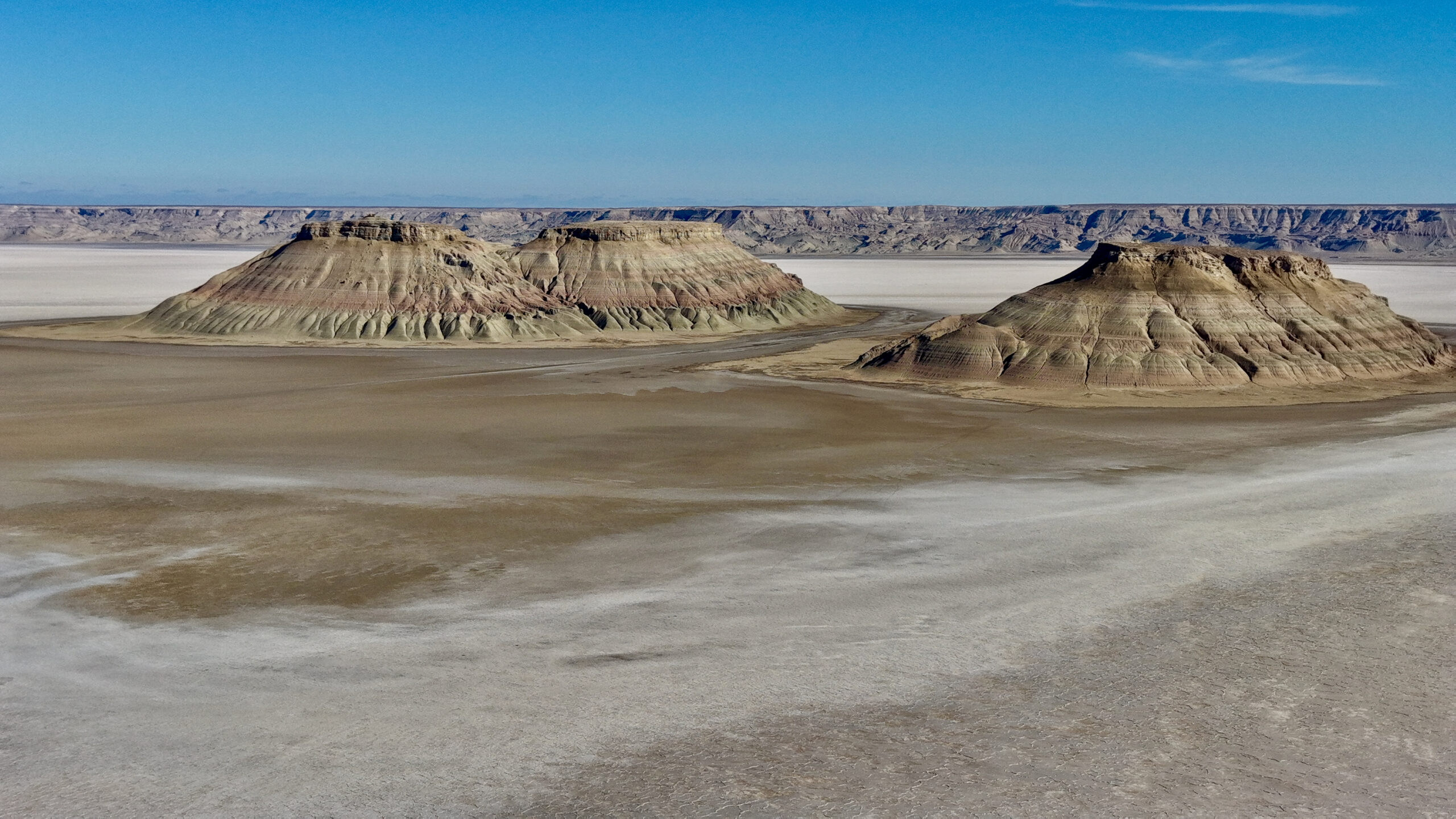
Today, the story of that vanished sea lies written in stone. In the Boszhira Valley, towering limestone cathedrals rise from the desert floor, glowing white beneath the sun, their spires shaped by wind and time. On the Ustyurt Plateau, the land stretches endlessly, a mosaic of salt flats and chalk ridges shimmering like a mirage. And in Torysh Valley, something extraordinary waits—thousands of spherical rocks, called concretions, scattered across the plain as if giants had played marbles with the bones of the Earth. Beneath the surface, salt domes heave upward, pushed by tectonic forces older than memory. This is not just a landscape—it is a living archive of geology, a window into epochs long gone. I came here with a camera, a backpack, and a quiet need I could not name. Perhaps it was solitude I sought—or the space to listen again. The road stretched endlessly ahead, cutting through emptiness that was anything but empty. The further I went, the more the noise of the world fell away, replaced by wind and silence. “Solitude is not the absence of people, but the presence of oneself,” Carl Gustav Jung once said. In Mangystau, those words find their meaning. Out here, solitude is not isolation—it’s revelation. The land mirrors the self: ancient, layered, shaped by forces unseen. Every canyon whispers of change, every rock holds a fragment of time.
When night falls, the desert exhales. The heat fades, and the stars bloom—millions of them, sharp and close enough to touch. I sit on a limestone ledge, the camera beside me, and feel the weight of stillness settle around my shoulders. I did not come here to escape the world. I came to remember something the world made me forget: that within each of us lies a vast and ancient silence—the same silence that shaped these cliffs, that moved unseen beneath the ocean long before our names were written. Out here, where the Earth still breathes in deep time, I begin to hear that silence again. It is not empty; it is full of presence, of knowing, of becoming. In Mangystau, the world no longer speaks in demand. It speaks in wind, in stone, in the slow hum of eternity. And for a moment, standing among these colors and cliffs, I understood: I have not come to discover this land. It has come to reawaken me. Mangystau — Once an ocean, now a silence of stone— the Earth remembers what we forget. Wind carves the hours, cliffs hold the centuries, and time lies open like an unwritten page. I walk here not to find the land, but to hear the part of myself that only speaks in solitude. In this desert of deep time, nothing is empty — not the sky, not the stone, not the quiet within.
“In every kaleidoscope of colors lies the science of deep time: minerals rearranged by heat, stone sculpted by erosion, and ancient seabeds rising to meet the sun.” – R.H.
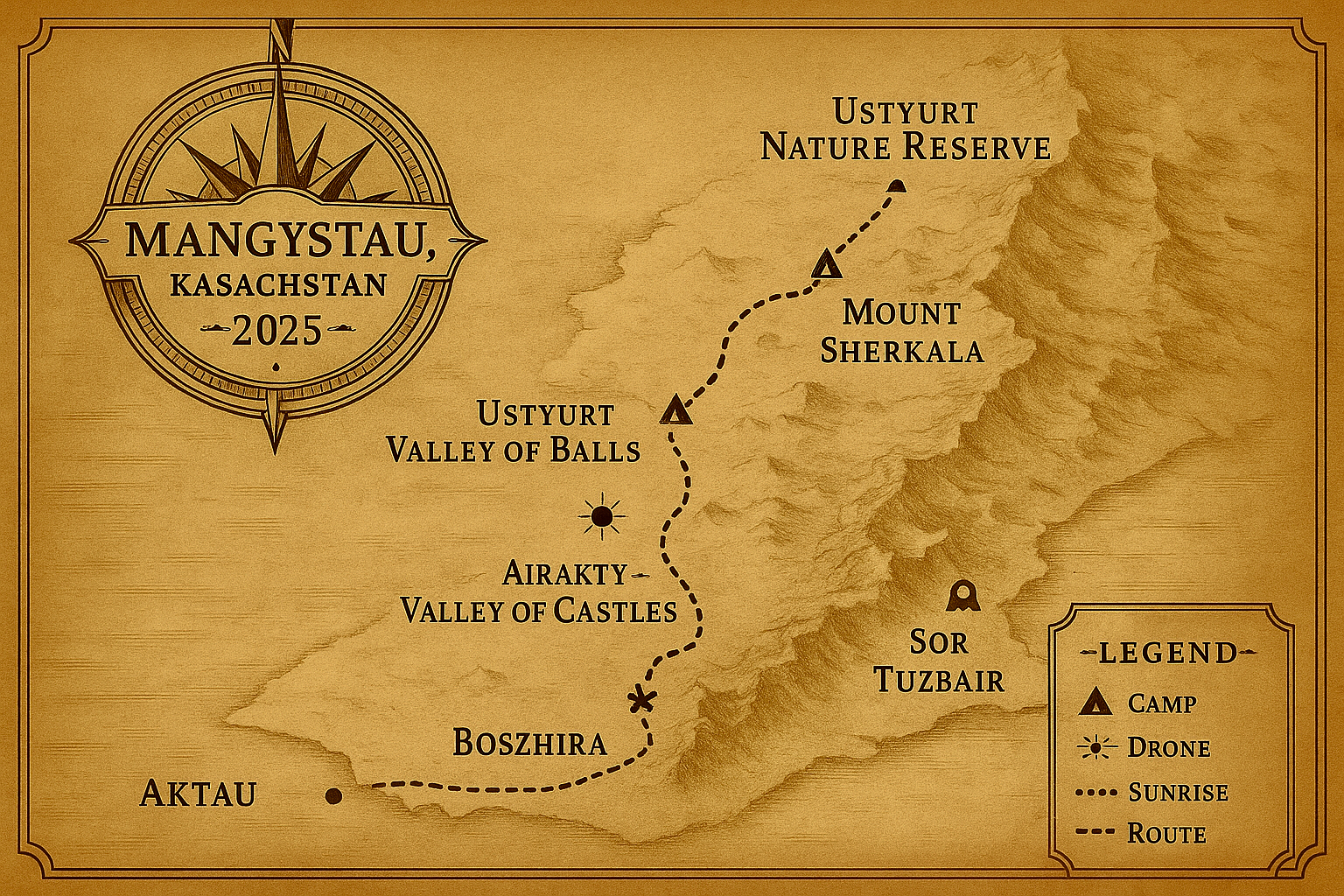
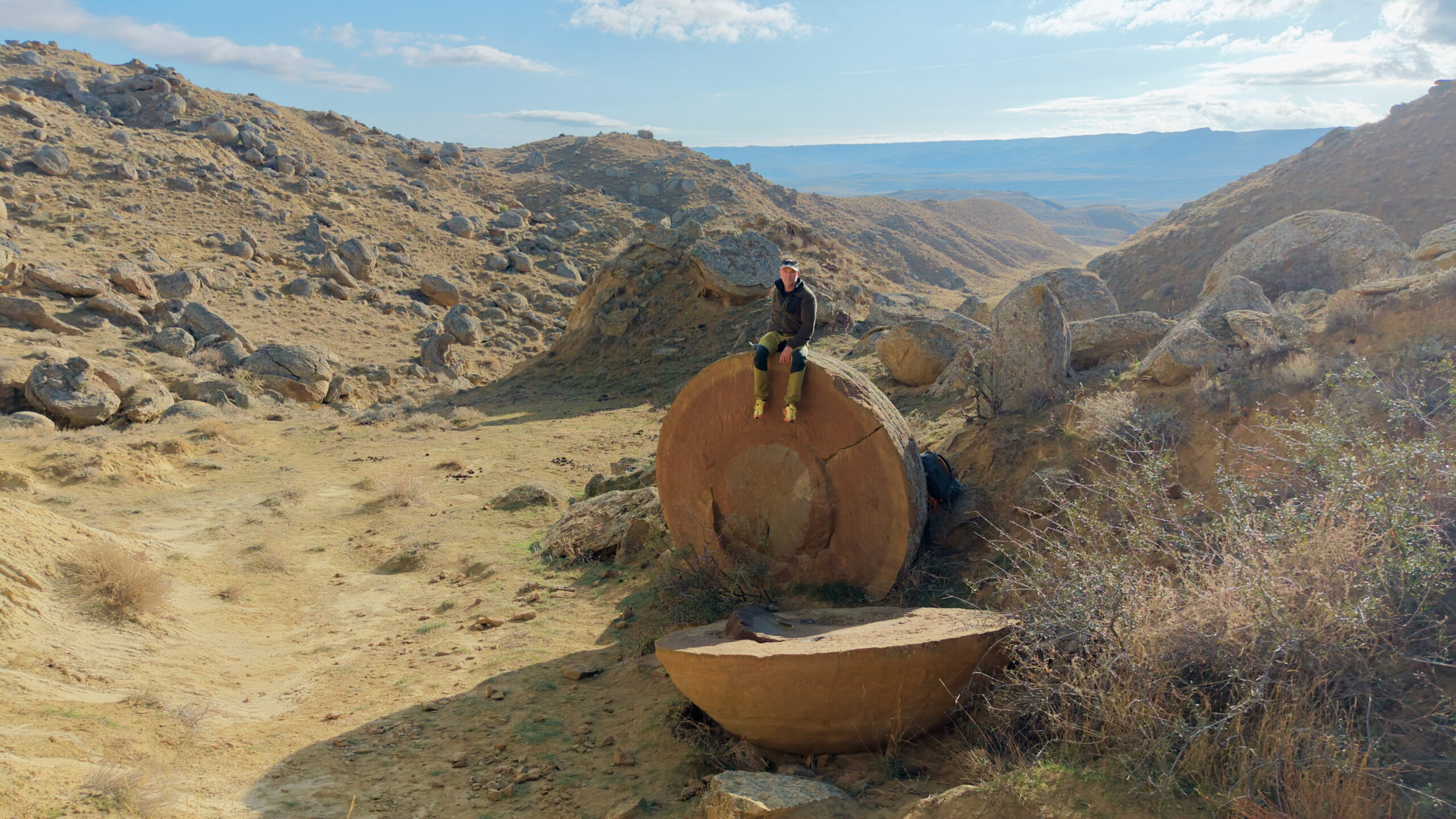
The Shape of Silence – My first encounter with the land was the Valley of Balls—Torysh. You can’t quite prepare for it. Dozens, maybe hundreds, of perfectly round boulders are scattered across the desert like marbles dropped by some careless giant. Their smooth, alien shape seems impossible. But they’re real—born from ancient ocean life: shark teeth, shells, plant matter, cocooned in minerals over millions of years beneath the Tethys Sea. I walked between them in silence. There was no path, only instinct. The wind carried nothing but its own voice. It was the kind of quiet that invites your thoughts to rise—unfiltered and unfamiliar. Later, I stood in the cool shadows of a 17th-century underground mosque, carved straight into the rock. No tourists. No signs. Just a stone threshold, and a hush so deep it pressed against my skin.
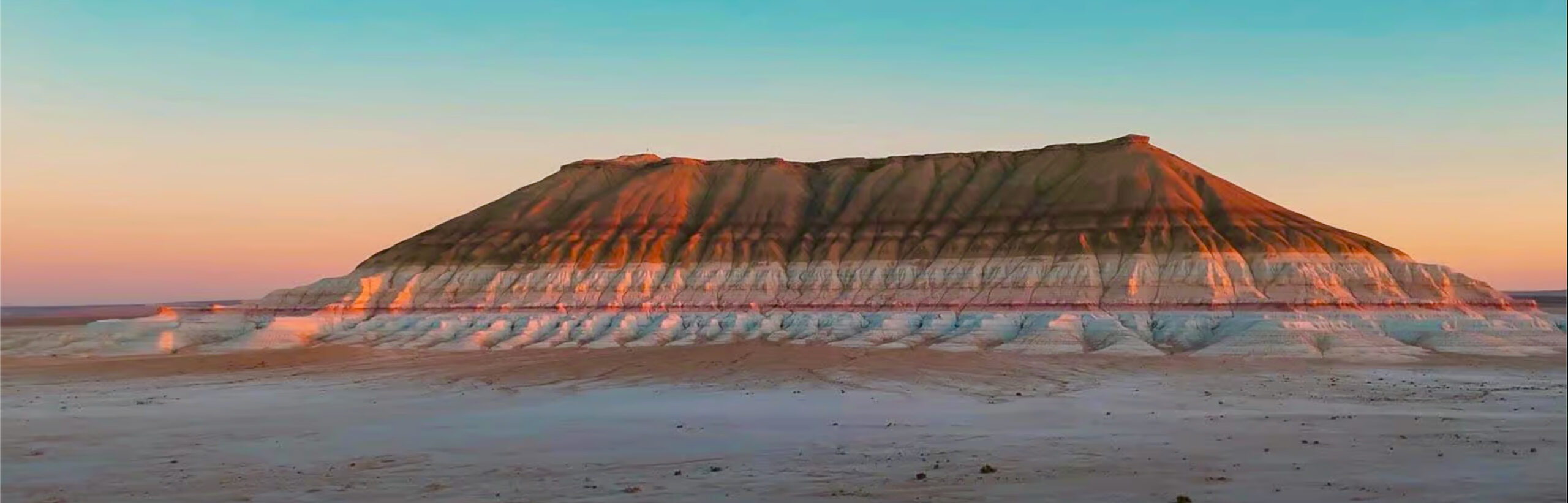
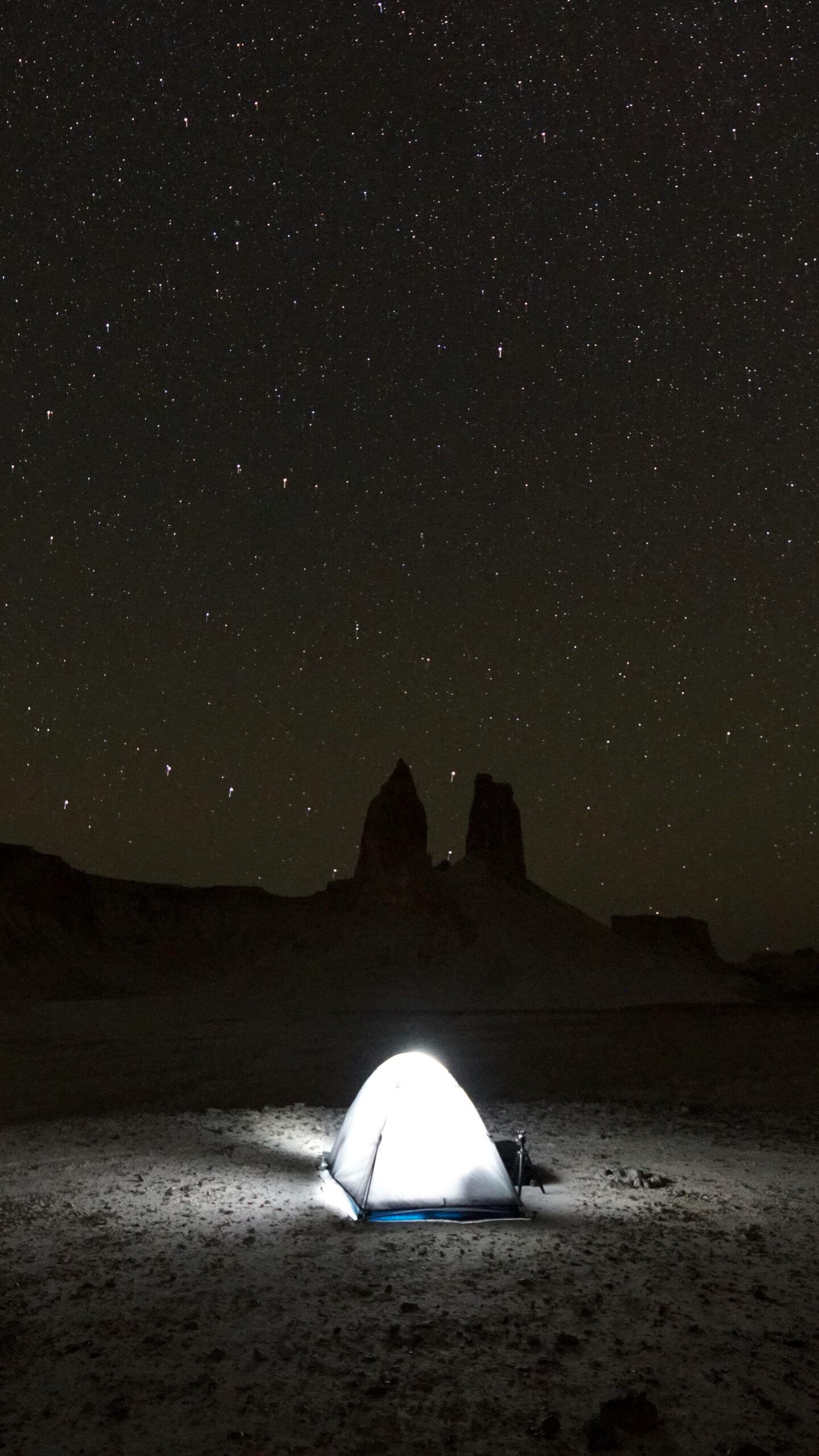
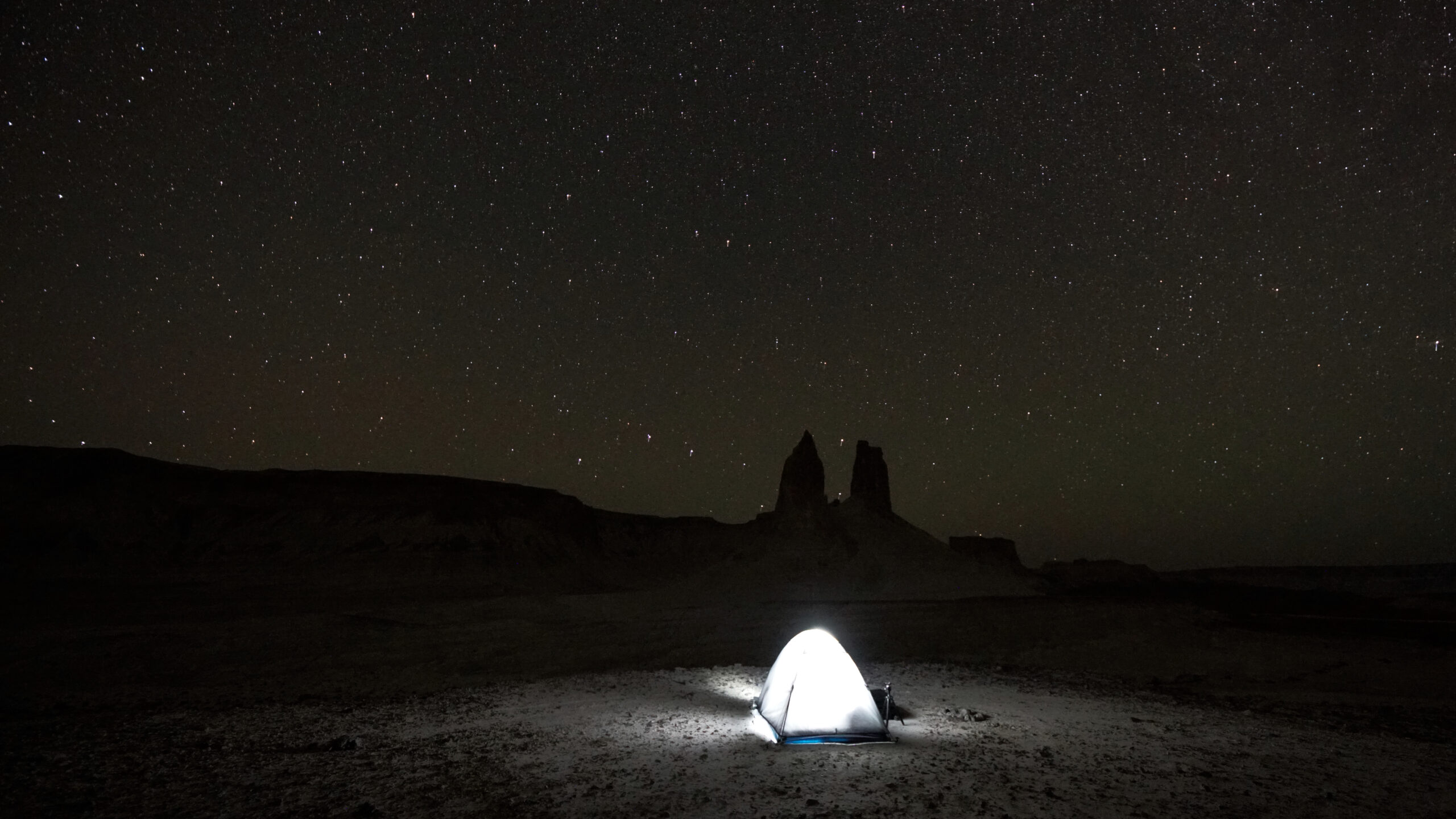
By evening, I reached Mount Sherkala. From the road, it looked like a flying saucer. From another angle, the paw of a lion. Locals refer to it as the “Lion Fortress.” It stood there, quiet and stoic, as I pitched my tent at its feet. That night, the stars fell open above me like a question I wasn’t ready to answer. The Stillness Between – In wild places, solitude isn’t empty. It’s full. It teaches you how to be present in your skin. Some places do not ask for words. They do not want to be explained, only experienced. In solitude, I do not look for answers—I make space for mystery.
As an explorer, I study the land with my senses first: silence, space, and stillness. As a scientist, I know the story — these are concretions, nodules formed on the seabed of the Tethys Ocean more than 40 million years ago, with mineral layers crystallizing around a tiny heart of life: a shell, a tooth, or a fragment of bone. But as a storyteller, I can’t help wondering if these spheres are more than a geological accident: if the Earth sometimes preserves symbols the way humans preserve memory. That’s when I shift from observer to participant. I don’t just photograph the valley — I breathe with it. The horizon becomes a prayer line. My shadow is the only companion moving across the dust. The deeper you walk among these stone orbs, the more you feel as though you are crossing some threshold between memory and myth. In Kazakh folklore, it is said that Torysh was once a battleground where warriors turned to stone, or the remnants of giants transformed into boulders overnight. Standing here, I understand why people needed a myth to make sense of it.
“Even when you know the science, some formations refuse to stay ordinary — they turn the earth beneath your feet into a quiet miracle.” – R.H.

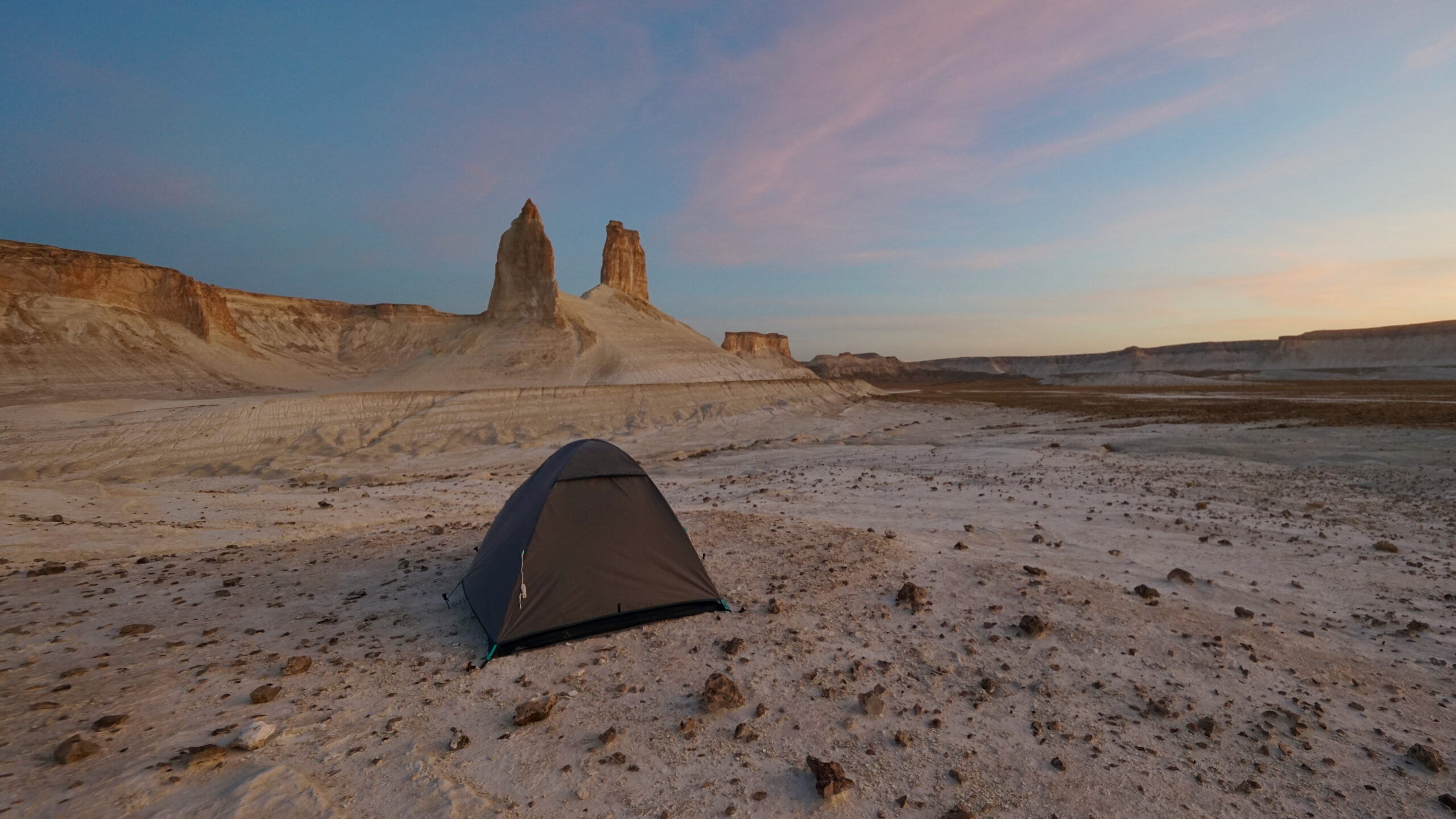
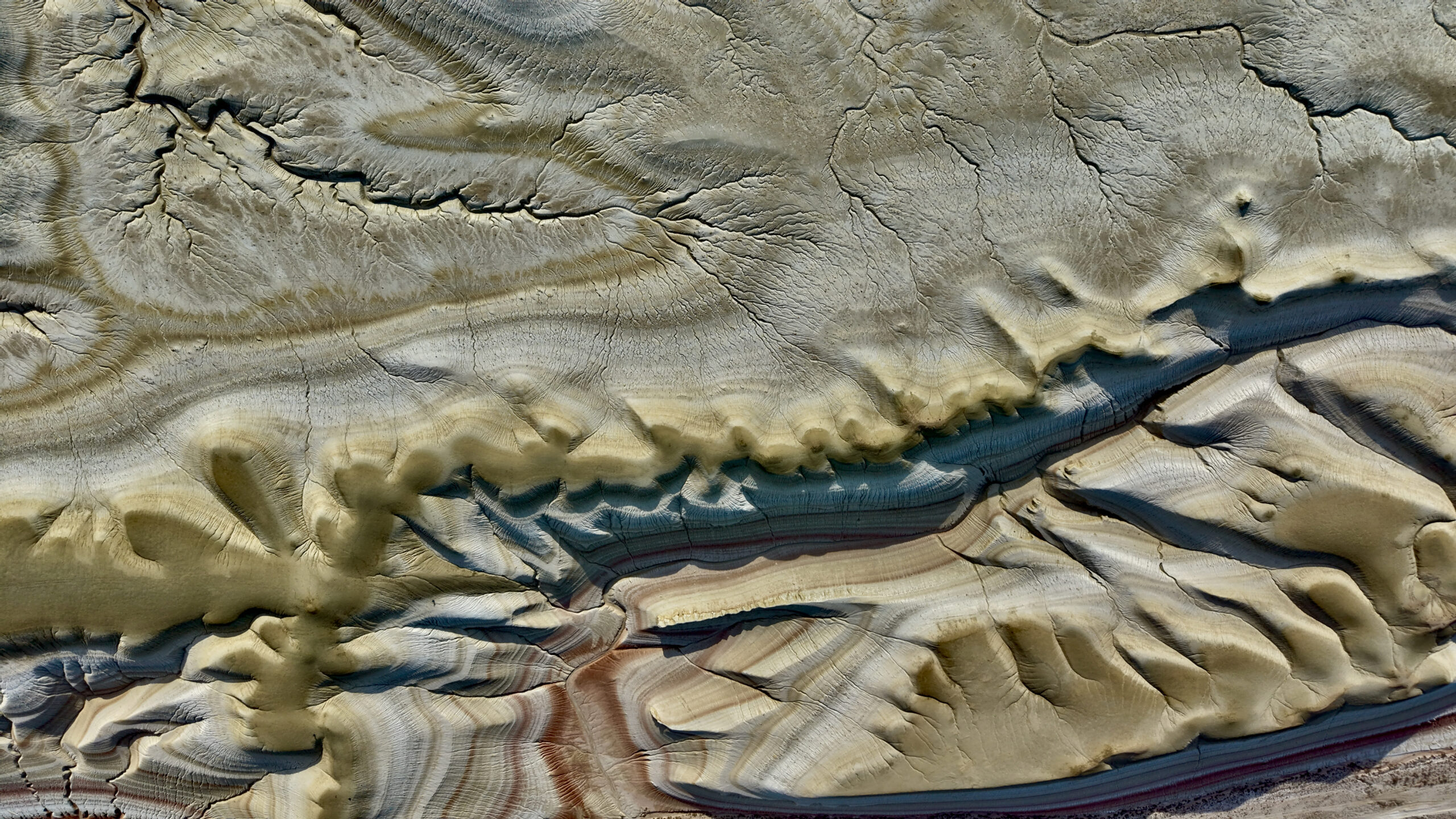
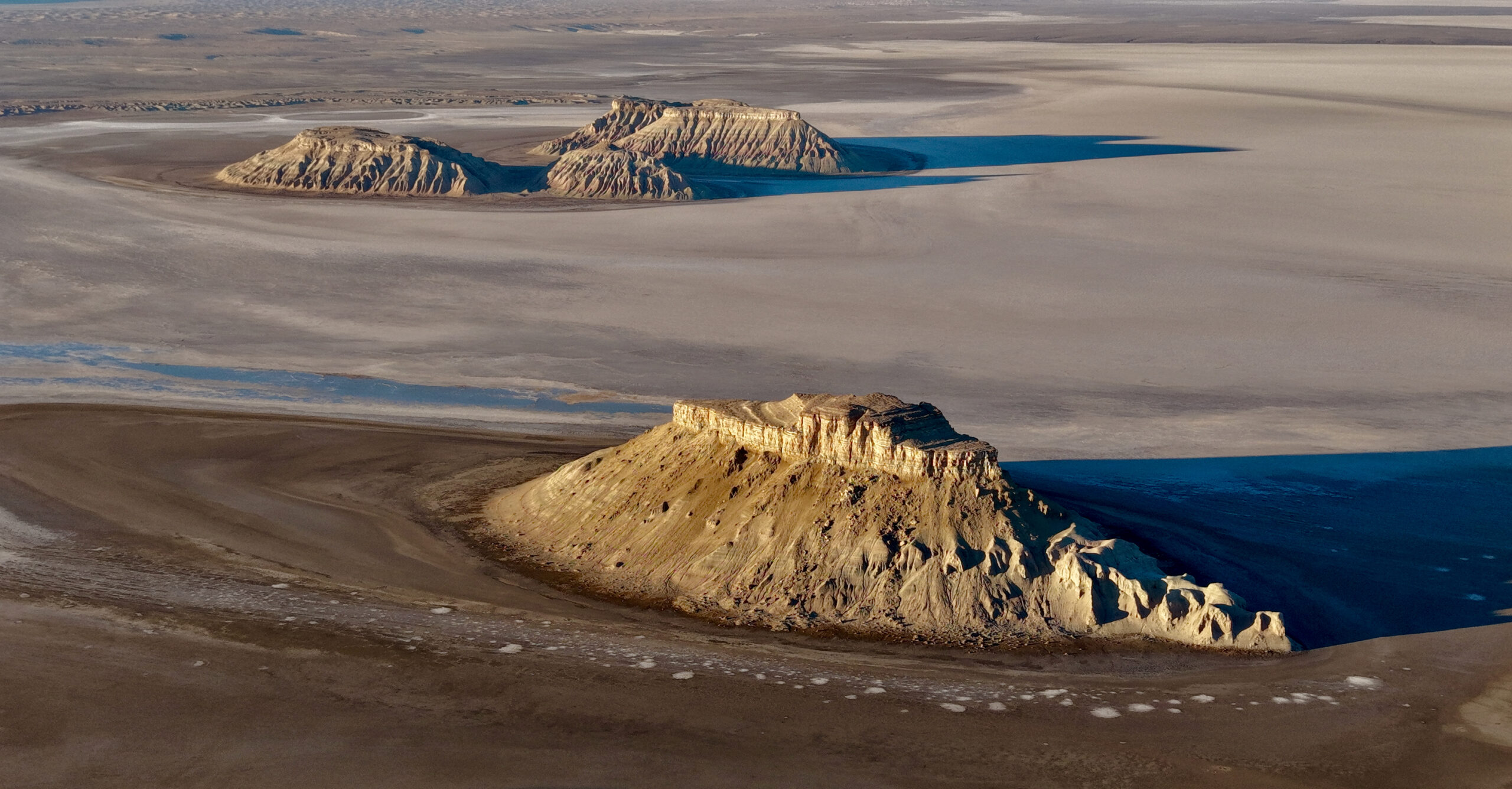
Castles of Wind and Bones – At dawn, Sherkala blushed pink under the first light. I packed camp in silence, the air still cool, the kettle’s last steam rising like a ghost. The road—if you could call it that—was nothing more than a suggestion drawn by memory and instinct. I shifted the 4×4 into low gear, the tires biting at gravel and salt crust as I headed toward Airakty, the so-called Valley of Castles. Soon, the world became dust. It seeped into everything—camera, gear, pores. The wind carried it in steady sheets, whispering through every crack of the vehicle. Navigation was a negotiation between compass, gut, and patience. Out here, GPS was less true than theory. The horizon played tricks, folding and shifting like heat itself had a will.
When the valley finally opened, I understood the name. Cliffs and ridgelines rose like ruined battlements—cathedrals sculpted not by hand but by centuries of wind and rain, sand and sun. The light sharpened their edges until the landscape looked both ancient and newly born. I often stopped, stepping out into silence so complete it pressed against my eardrums. The heat came fast. Water, slow to drink, felt like gold. Each mouthful was calculated—just enough to stay sharp, never enough to waste. Every ridge I climbed revealed another kingdom of stone, every shadow another illusion of refuge. The driving was a dance between momentum and caution. Too slow, and the wheels sank into powder-soft dust. Too fast, and the sharp rock threatened the tires. There were no signs, no markers, only instinct and the pale traces of wind-erased tracks. It felt less like traveling along land and more like being swallowed by it.
By afternoon, the wind picked up—dry, insistent, unkind. I searched for a place to camp, scanning for a hollow, a curve of cliff that might offer shelter. The sun was still high, but out here, light deceives; dusk fell like a curtain. Eventually, I found a shallow basin at the base of a sandstone tower. It was no more than a fold in the earth, but it broke the wind. I set the tent quickly, anchoring it with stones and willpower. Dust gathered in every crease of fabric. When the burner hissed to life, it sounded louder than it should—a small defiance against the wilderness. As I ate, the cliffs turned amber, then rose—red, then gray. The valley shifted moods like a living thing. Mangystau is a place where the land holds memory like bone holds marrow. For thousands of years, nomadic tribes crossed these plateaus, leaving petroglyphs and stone altars scattered across the desert. Medieval caravan routes once threaded through these plains, linking Persia, Khwarezm, and the Caspian coast. Even before that, this entire region lay beneath the Tethys Sea—its ancient floor now rising as chalk cliffs, coral reefs turned to white mountains, and salt domes pushing the earth upward like slow-moving ghosts. Fossilized seabeds whisper of oceans long gone—salt flats gleam where water once dreamed. To walk here is to walk inside time itself, among castles of wind and bone. I felt small—but not lost. Out here, surrounded by stone and silence, I was finally in proportion.
“Castles of wind and bones tower above the desert like the ruins of another age — reminders that even the strongest worlds are sculpted by forces we cannot see.” – R.H.
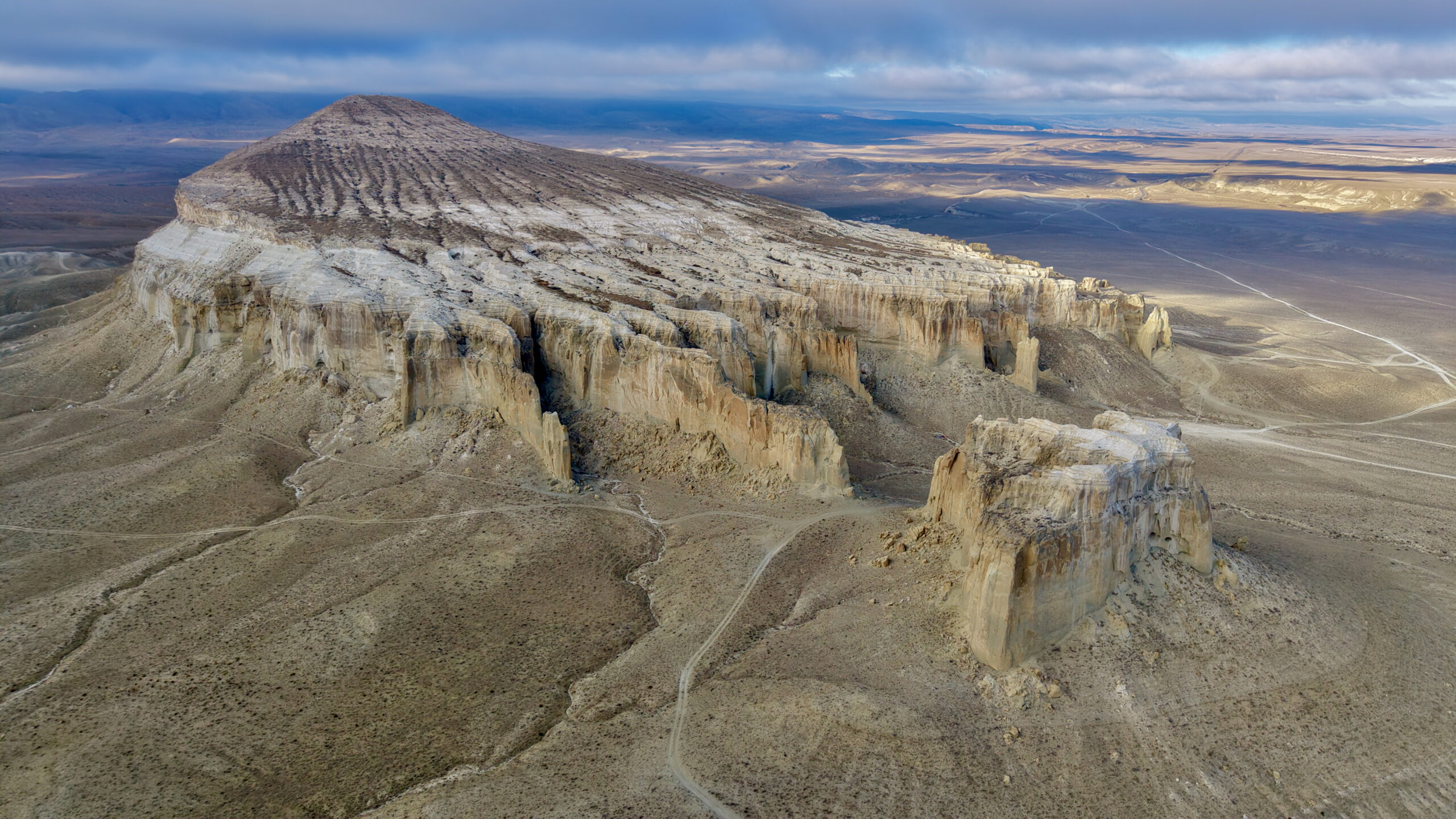
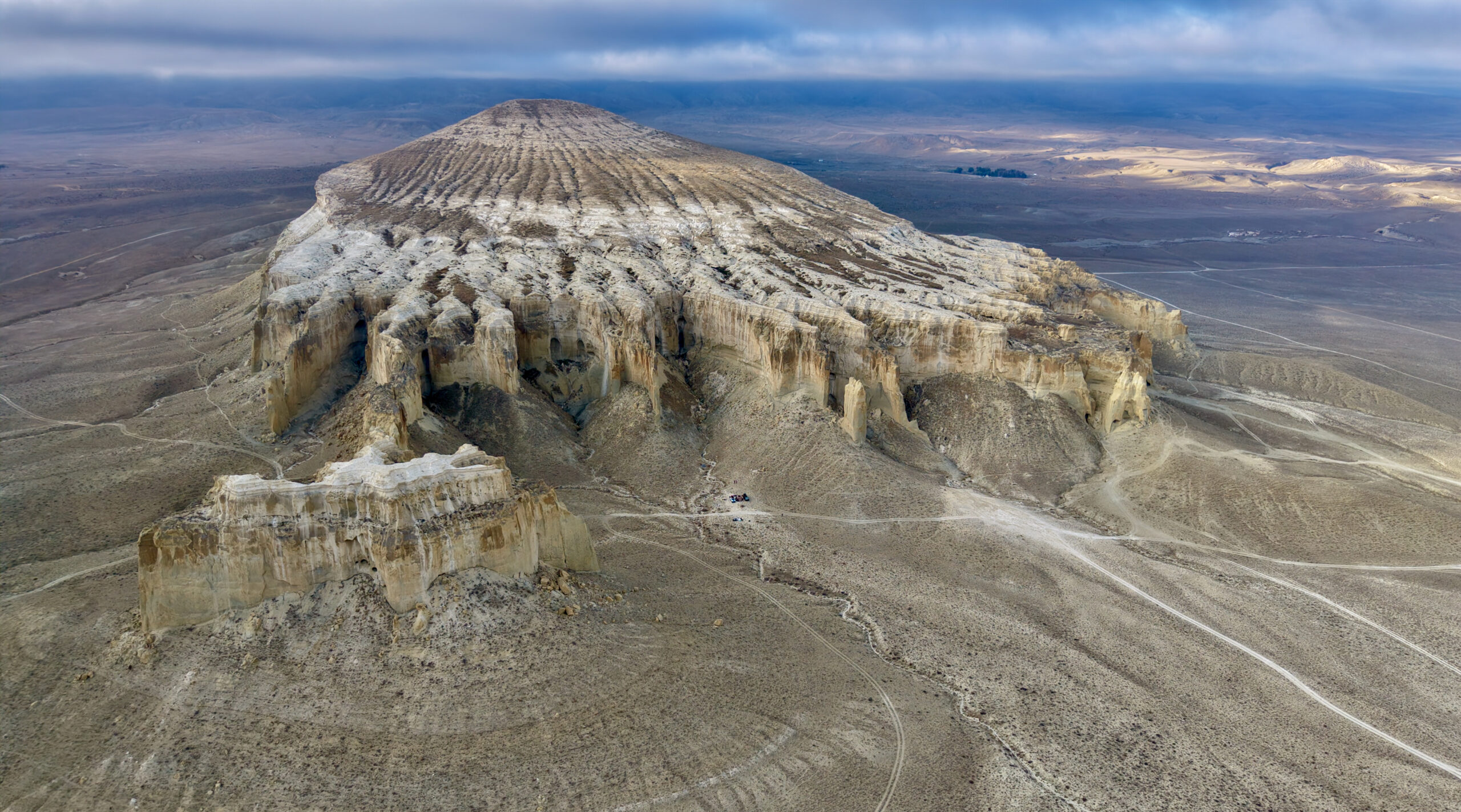
Salt and Silence – By dawn, the wind had softened, carrying with it the promise of heat. I broke camp quickly, shaking dust from every fold of fabric, though it never truly left. It clung to the gear, to my skin, to the memory of every track I had taken. I steered the 4×4 southeast, toward Tuzbair—one of Mangystau’s great illusions. The map showed distance, but out here, distance had no meaning. There were no tire marks to follow, only the faint lines of erosion carved by ancient floods. The desert shifted moods without warning—flat one moment, then breaking into canyons that swallowed all sense of direction. By noon, the horizon flickered white. At first, I thought it was light playing tricks again. But then, slowly, the shimmer solidified—the great salt flats of Tuzbair. From above, it looked endless, a pale sea that once knew tides and depth. I parked near the edge, engine ticking with heat, and walked toward the precipice. Below me stretched a world stripped to its essence: light, salt, and silence. The surface was crusted like cracked porcelain, the air sharp with minerals. Around it, the cliffs rose in shapes that defied reason—twisted, hollowed, layered in colors that didn’t seem real. Some looked like the roots of ancient trees, others like the vertebrae of a sleeping dragon. Getting down was its own battle. The descent was steep, the ground fragile. I eased the 4×4 down carefully, inch by inch, the smell of heated metal mixing with salt. When I reached the bottom, the wind stopped. It was as if the world had exhaled and forgotten to breathe again. My boots crunched over salt, each step echoing as if inside a vast cathedral. I cooked with the last of my water, saving enough for dawn. Out here, every drop mattered, every action carried weight.
The Art of Being Alone — Solitude has a rhythm. At first, it unsettles you—too much space, too much quiet. But slowly, you fall into its pattern. The noise of the world fades, and what remains is pure awareness. I didn’t come to Mangystau to find myself. I came to be with myself. There’s a difference. When night arrived, I lay on the salt and looked at the stars mirrored faintly on its surface. The world above and below became one. And for a while, I belonged to both. Mangystau lies in the far southwest of Kazakhstan, stretching across 165,000 km² of desert, plateaus, and sculpted limestone landscapes. Centered roughly around 43.8° N and 52° E, it borders the Caspian Sea and includes the windswept Mangyshlak Peninsula. Despite its vast size, the region is sparsely populated, with a population of approximately 740,000, most of whom reside in Aktau and a handful of industrial towns.
Mangystau’s terrain is extreme and diverse—from the Karagiye Depression at –132 m, one of the lowest points in Central Asia, to Mount Otpan rising 556 m above sea level. The climate is harsh and arid, with scorching summers, cold winters, and minimal rainfall. It is a land defined by distance, silence, and geological memory—where fossilized seabeds, salt flats, and towering chalk formations reveal the ancient story of the vanished Tethys Sea.
“Salt remembers what silence protects— one shaped by the oceans, the other by time.” – R.H.
The Valley of Monuments – Leaving Tuzbair felt like going to another planet. The salt still lingered in the air, dry and metallic, and the dust seemed to have found a permanent home in every fold of my clothes. I broke camp before sunrise, the horizon a faint blush of gold. The track toward Boszhira was little more than a rumor, carved by time and wind rather than tires. The 4×4 groaned as I steered it over endless ripples of corrugated earth. Every jolt rattled through the frame, through me. Sharp stones cut through the desert’s crust like shards of glass. One careless move and a tire would split miles from help. The compass became my confidant, the only steady thing in a landscape that shifted with light. Even the air seemed to waver, as if the desert itself were breathing. By noon, the horizon began to change—rising, folding, whitening. The first pale ridges of Boszhira appeared, ghostlike and immense. I drove closer, and the world opened into something unearthly: vast white cliffs, knife-edged peaks, towers rising like the bones of ancient titans.
Each kilometer felt like crossing into another era, and the journey was a trial of patience and nerve. When I finally stopped, the engine ticked in the heat, a small sound swallowed by silence. Boszhira doesn’t look like it belongs on this planet. It’s a cathedral of stone and emptiness. Light spilled across the valley in slow motion, turning the chalk cliffs to honey, then to rose, then to silver. I barely spoke for two days. The place demanded reverence, not words. At dawn on the second morning, I climbed a ridge and sat at its edge, legs dangling over the abyss. The air was still, the world waiting. I looked up, and the stars that had guided me through the night were fading in the new light. Everything I saw above had traveled across hundreds of millions of years to reach me—ancient photons, ghost light from stars long dead. Then I looked down. Beneath my boots were layers of fossilized seabeds, sediments older than any dream of humankind. And at that moment, the thought struck hard and clear: everything above and everything below is ancient. We live between them—our lives, in universal terms, are the flicker of a shooting star. The realization wasn’t frightening. It was freeing. The horizon stretched forever, but the importance wasn’t in reaching it—it was in being here, awake, alive, breathing the dust of eons. I sat there until the sun climbed high, and the shadows disappeared. The desert offered no answer, no comfort, no purpose—only perspective. And that, I realized, was enough.
Side note: I highly recommend traveling with Dmitry Arkhipov, especially if you have limited experience with remote or demanding destinations. Arkhipov is a renowned Russian photographer, explorer, and expedition leader, widely respected for his striking, high-contrast imagery of some of the planet’s most inaccessible regions. His expertise spans polar expeditions in Antarctica and the Arctic, as well as the deserts and plateaus of Central Asia—including Mangystau, where he regularly leads expertly curated photography tours. More information: Dmitry Arkhipov
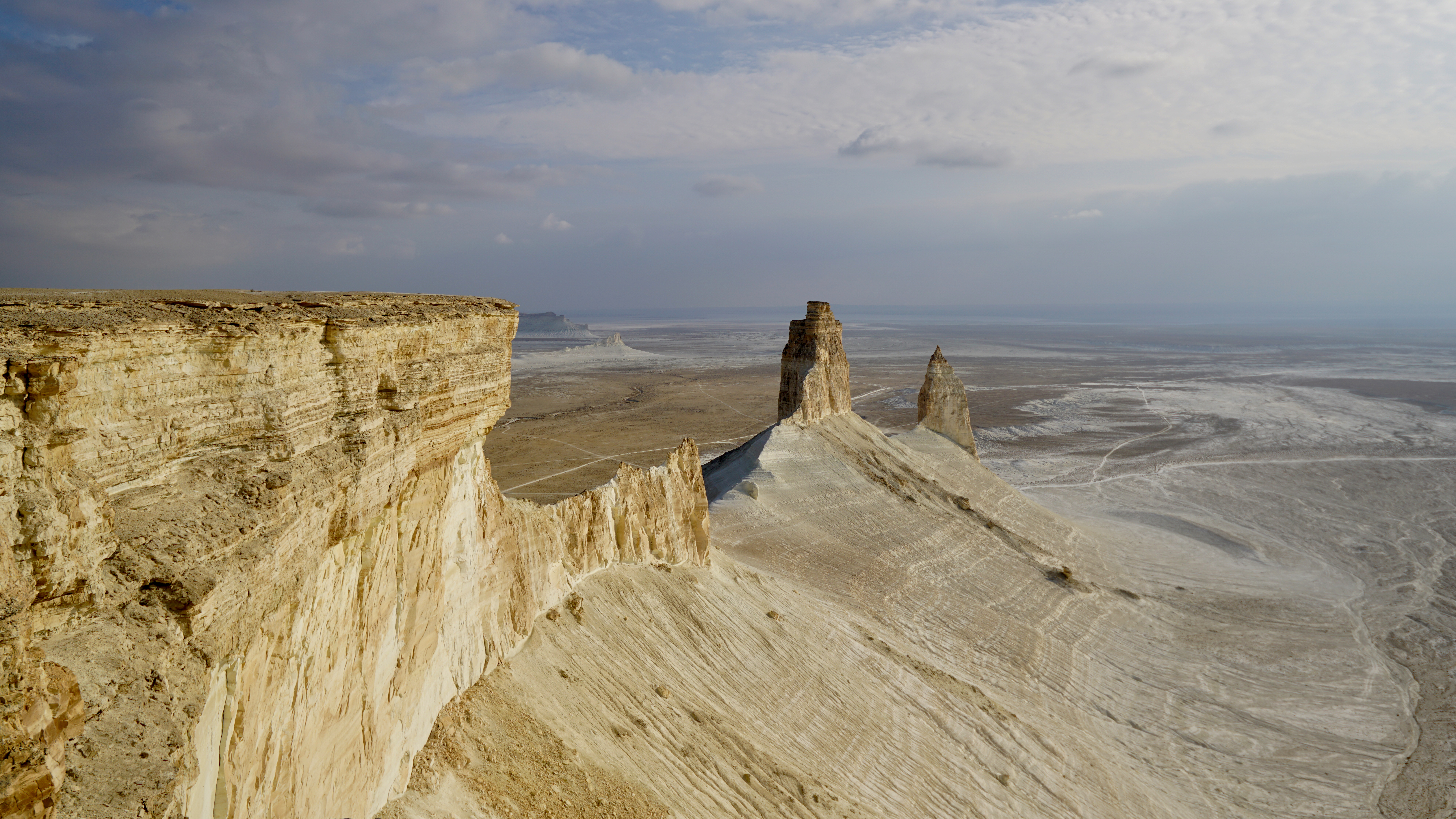
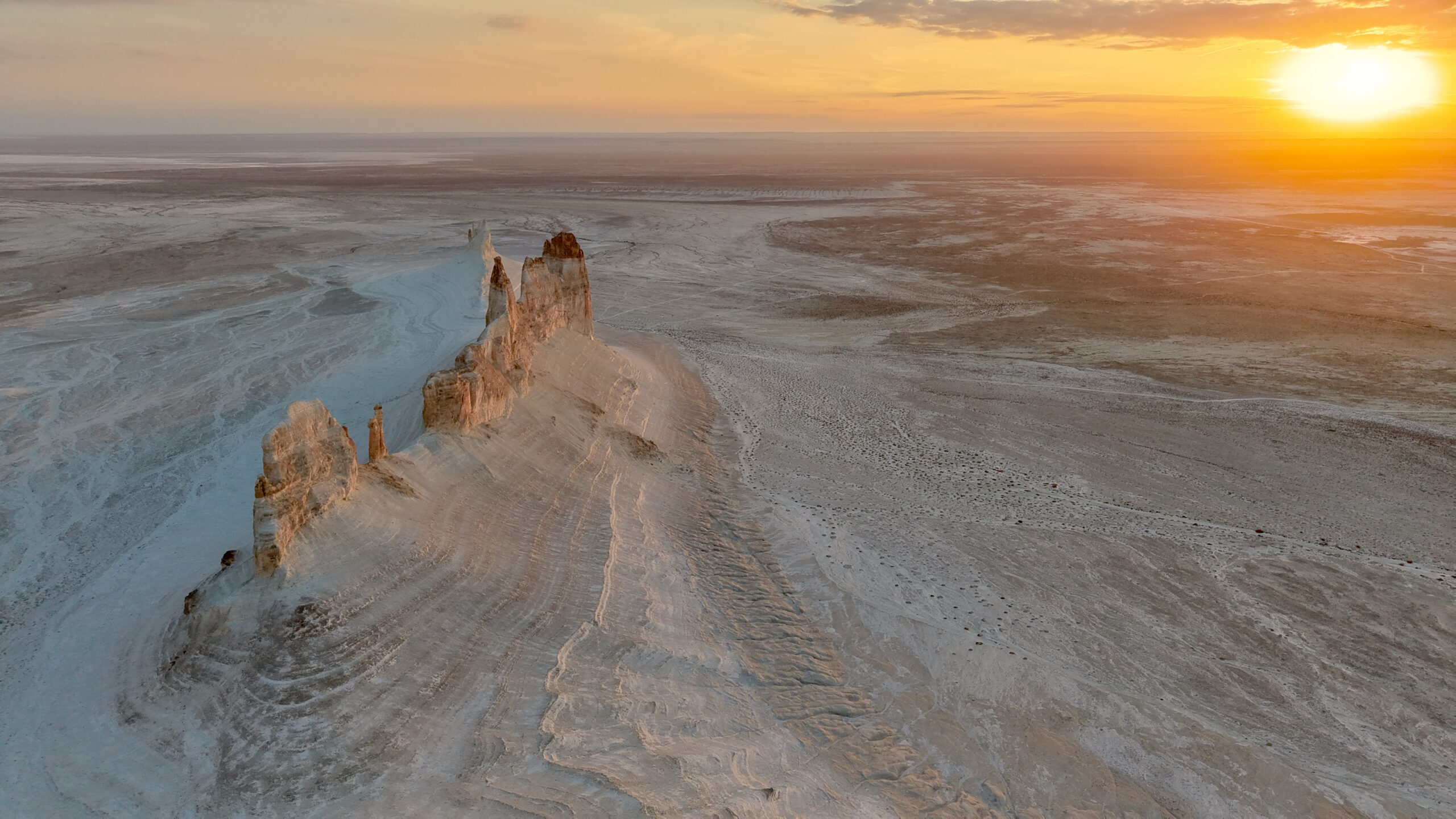
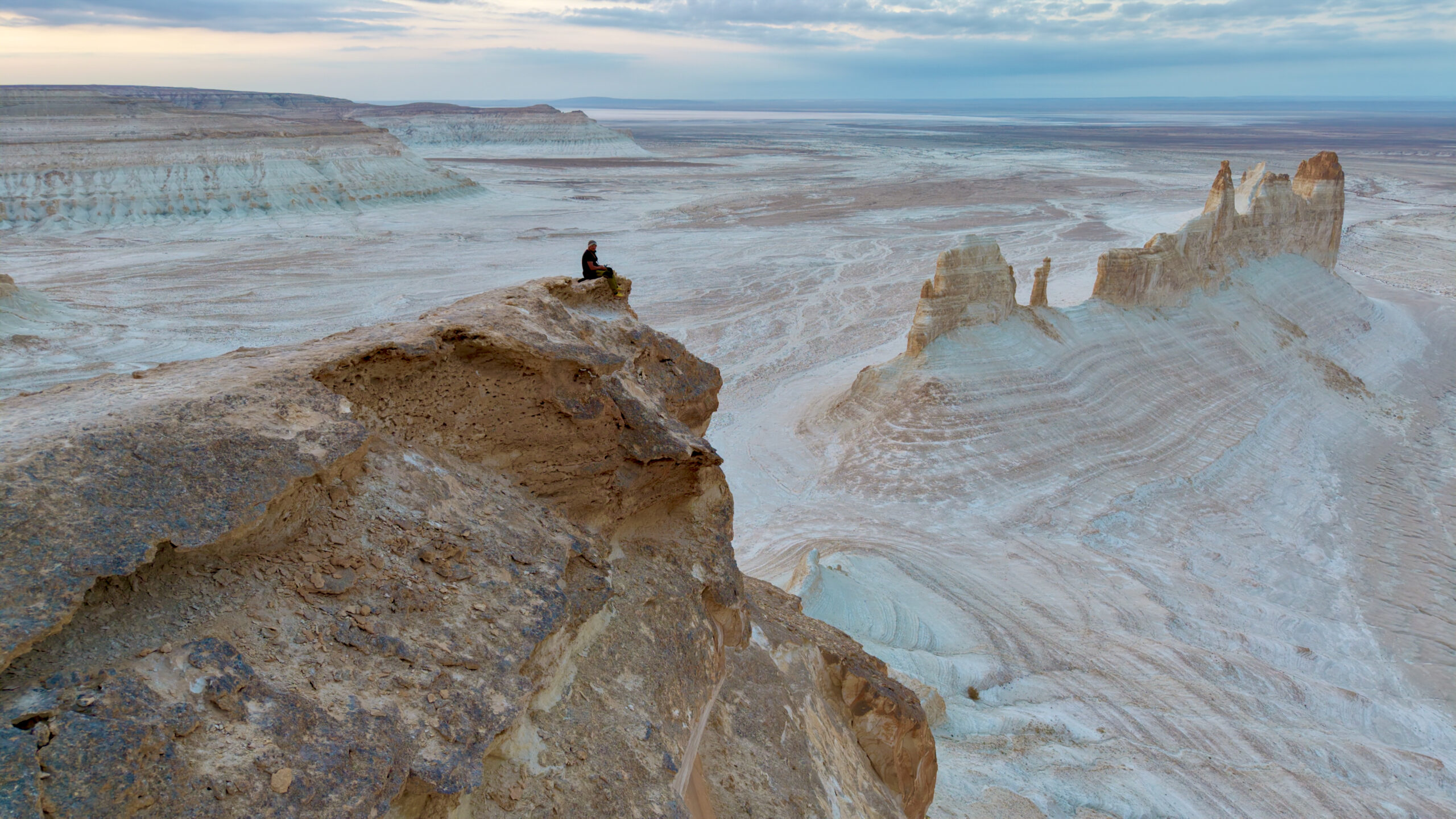
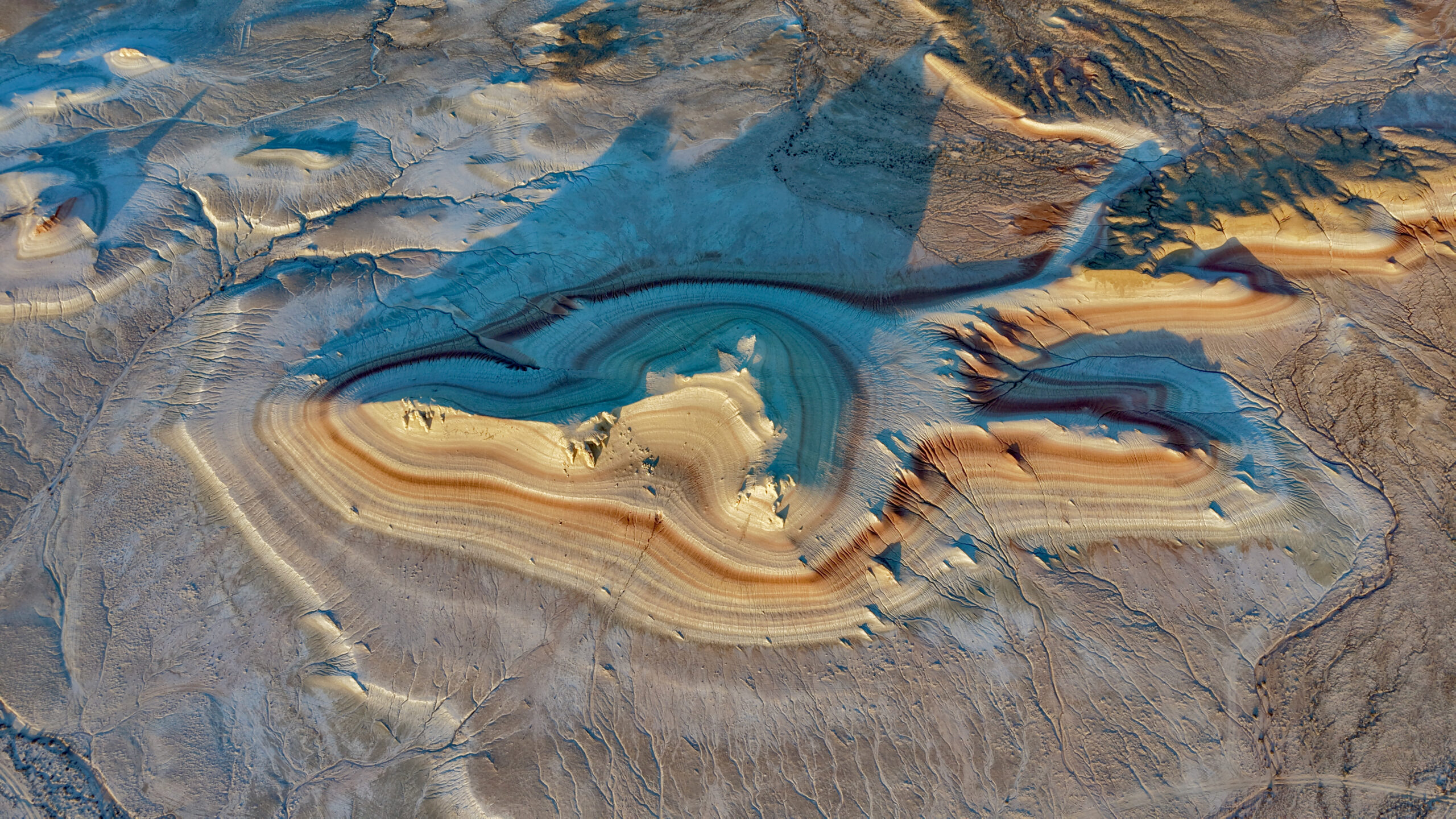
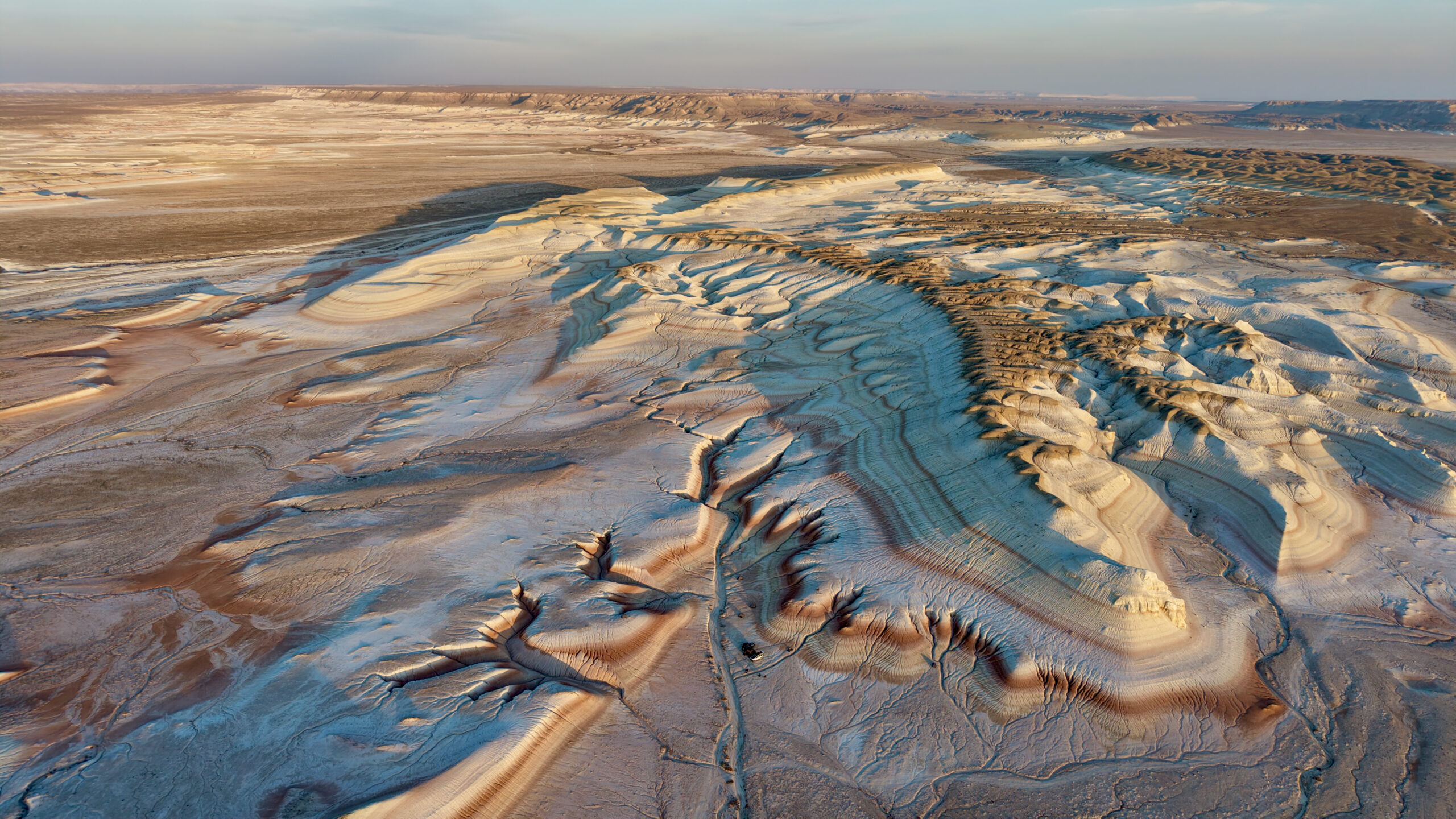
Time Folded Into Stone –The road south from Boszhira was a slow unraveling of stone and silence. The 4×4 crawled through dust storms that appeared without warning, their edges curling like smoke over the horizon. I drove by sound more than sight—the steady hum of the engine, the rattle of rock against the chassis, the low whistle of wind through an open window. Every few kilometers, I stopped, stepped out, and listened. Out here, wind is not just weather—it’s language. It tells you when to move, when to wait, when the desert has changed its mind. By noon, the cliffs softened into rolling hills painted in impossible hues. The land bled from white to amber, from rust-red to pale lemon, until color itself felt alive. Then I saw it—Kyzylkup, better known by its more fitting name: Tiramisu Gorge. And it did fit. The earth was layered like memory, each stratum a line of history pressed into form—bright white, ochre red, and soft gold stacked like the delicate folds of a desert pastry.
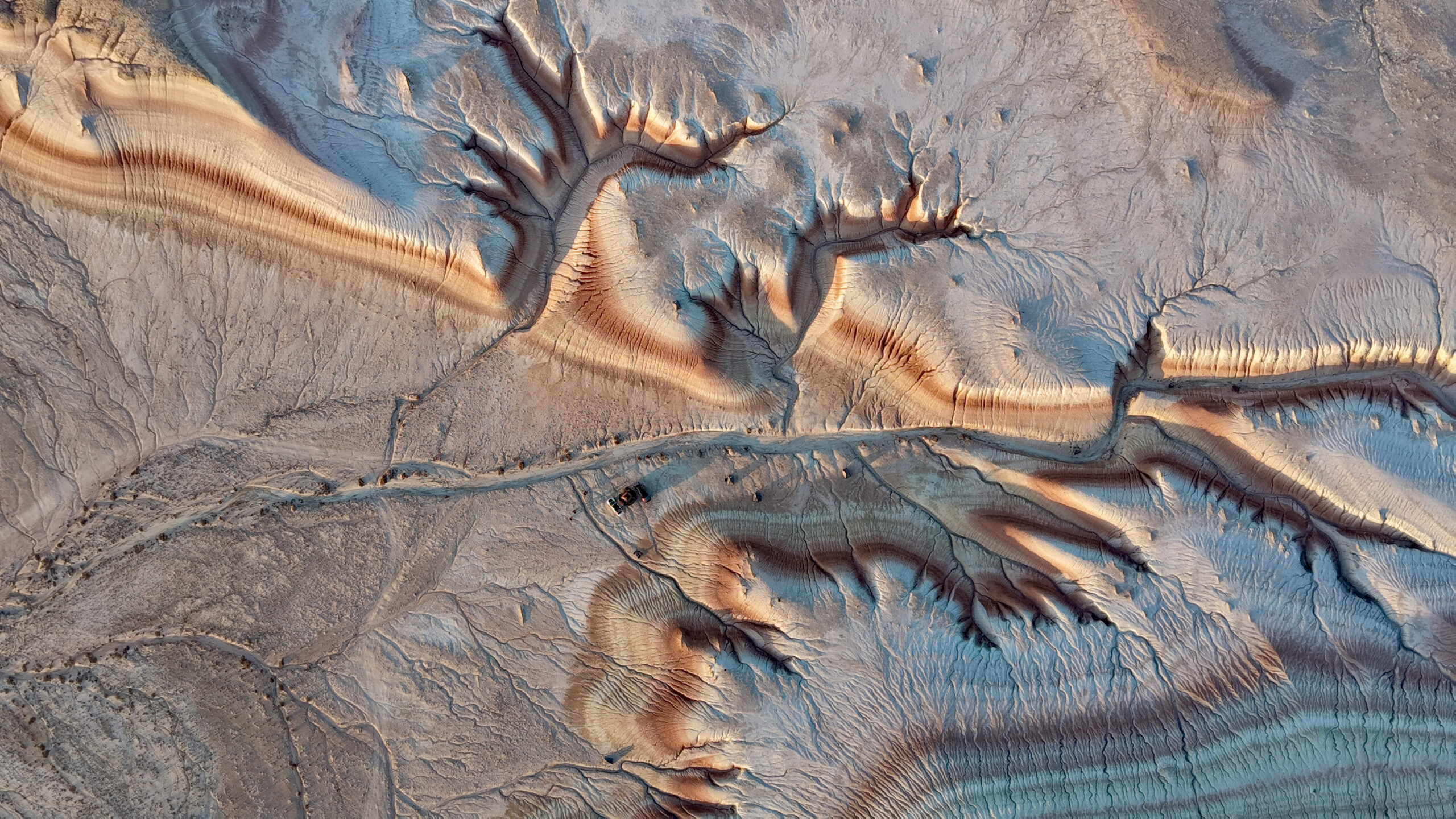
Walking through it felt like walking through time. The ground beneath my boots was powdery, brittle, whispering secrets of the ages. I ran my hand along a wall and felt how fragile permanence really is. Erosion had written its own scripture here—wind as ink, time as brush. Stone is time, folded until it becomes form. I launched the drone to see what my eyes alone could not grasp. From above, Mangystau revealed itself in a language of patterns—ridges coiling like waves, plains bleeding into salt, fractures running like veins across an ancient body. The camera rose until the gorge became a painting—tones of cinnamon, ivory, and rose layered with shadow. Up there, it made sense. Mangystau isn’t meant to be seen from a single angle. It’s a place you understand only by rising above it—by listening, by looking, by letting the land tell its own story. To the east stood Mount Bokty, a perfect geometry of earth, rising alone like a monument to symmetry. Something was calming about its shape, as if the desert had poured itself into one final, flawless form. I parked the 4×4 near its base, made camp, and watched the light fade until Bokty glowed like an ember against the sky. That night was my last in Mangystau. I sat by the fire, the drone packed away, listening to the same wind that had carved these valleys, stripped these cliffs, sung through this desert long before me. The stars returned—silent witnesses to millions of years of shifting stone.
Leaving the Silence – When I packed up my tent the next morning, I felt different. Not fixed. Not transformed in any grand sense. Just honest. I hadn’t solved anything out here, but I had come closer to myself than I’d been in years. Mangystau didn’t change me—it revealed me. And I know this now: there are places we travel to because we want to see them, and others we are drawn to because some quiet part of us is already waiting there.
“At Mount Bokty, times folded into stone rose like colorful cathedrals—proof that even silence can grow into mountains.” – R.H.
Beneath the Milky Way – The road back toward Aktau felt different. It was the same terrain—dust, ridges, and the long hum of the 4×4—but the weight of the journey had changed. Mangystau had peeled away the noise, leaving only what mattered: motion, silence, breath. Every kilometer carried a sense of return, not to civilization, but to understanding. Out here, time stretches. It breathes differently. Each sunrise feels earned, each shadow deliberates. But soon the horizon would give way to roads, schedules, signals—the pulse of a world that never pauses. Most people, I thought, are trapped in that rhythm: the relentless tick of tasks and notifications, the illusion that busyness equals purpose. We measure our days in deadlines, not distances; our worth in output, not awareness. The desert has no patience for that kind of blindness. It teaches by subtraction—removing the unnecessary until truth remains. In the stillness of Mangystau, I began to sense how distorted our idea of time has become.
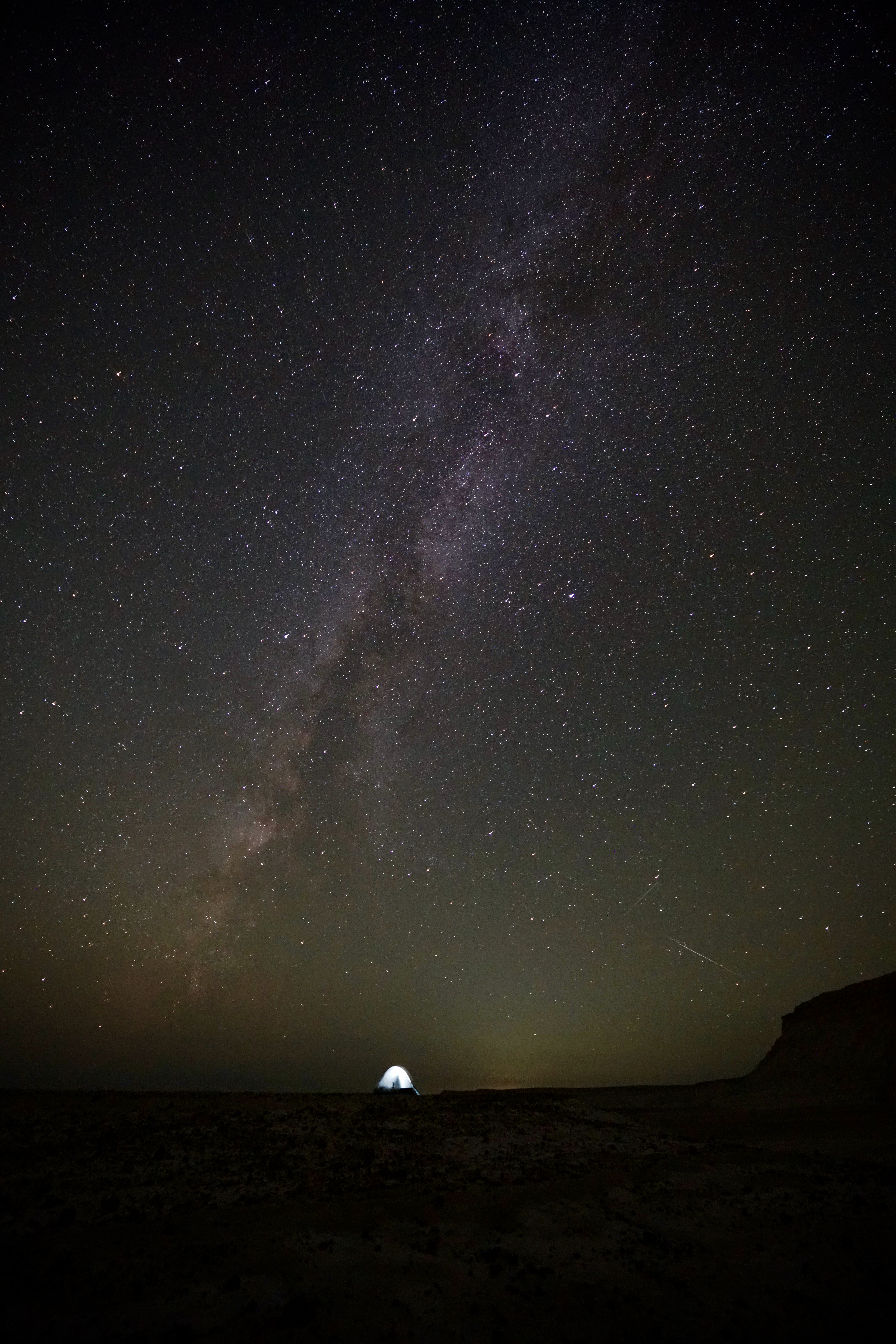
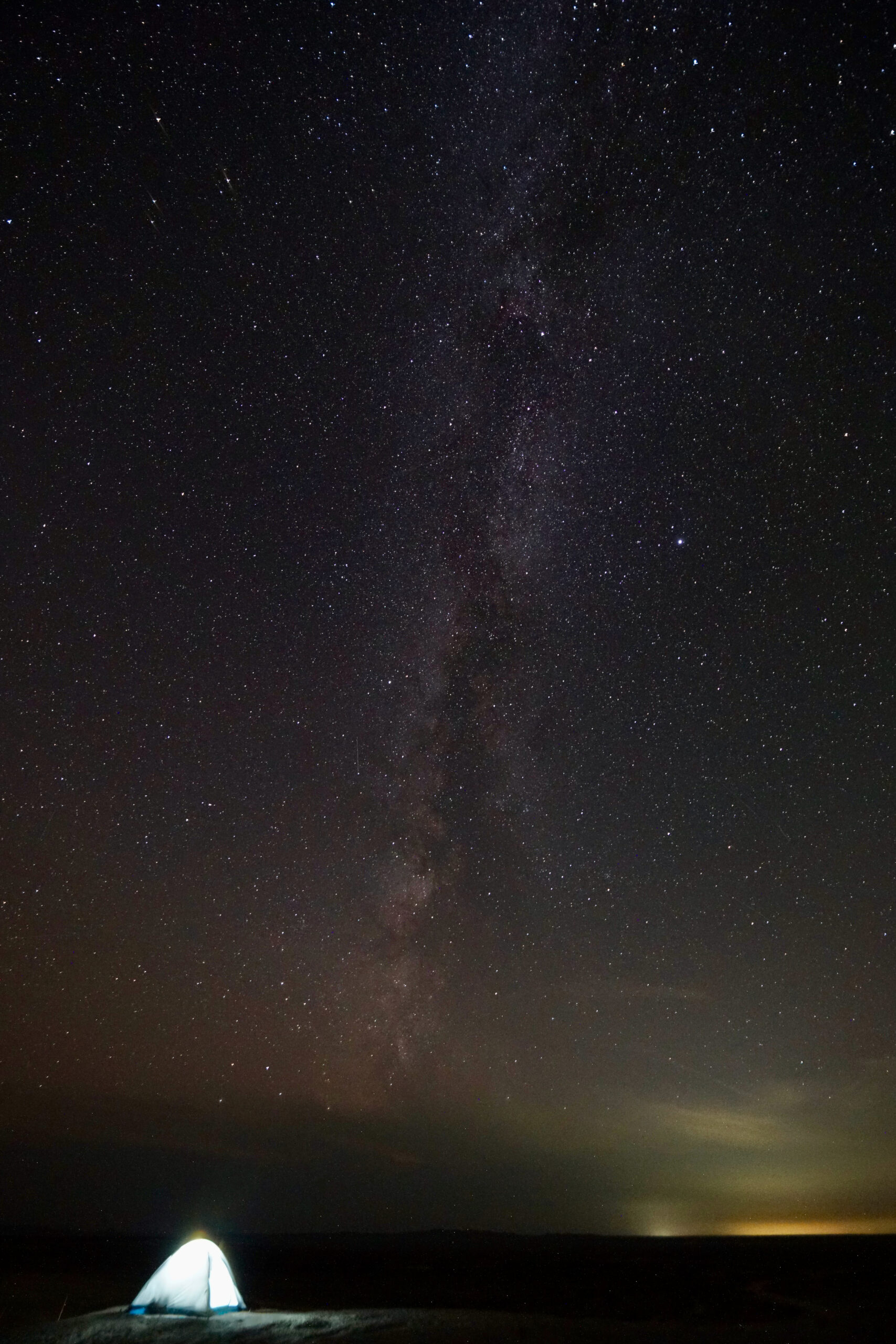
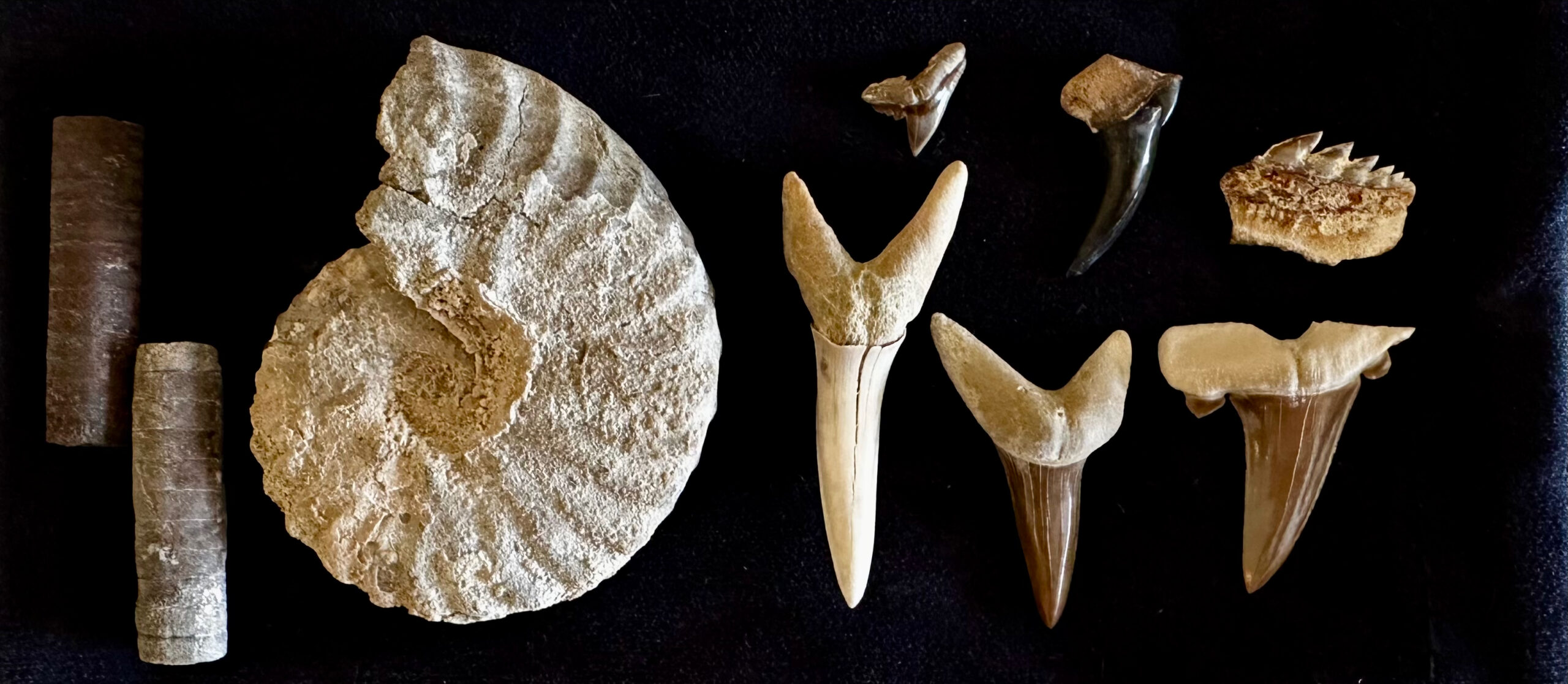
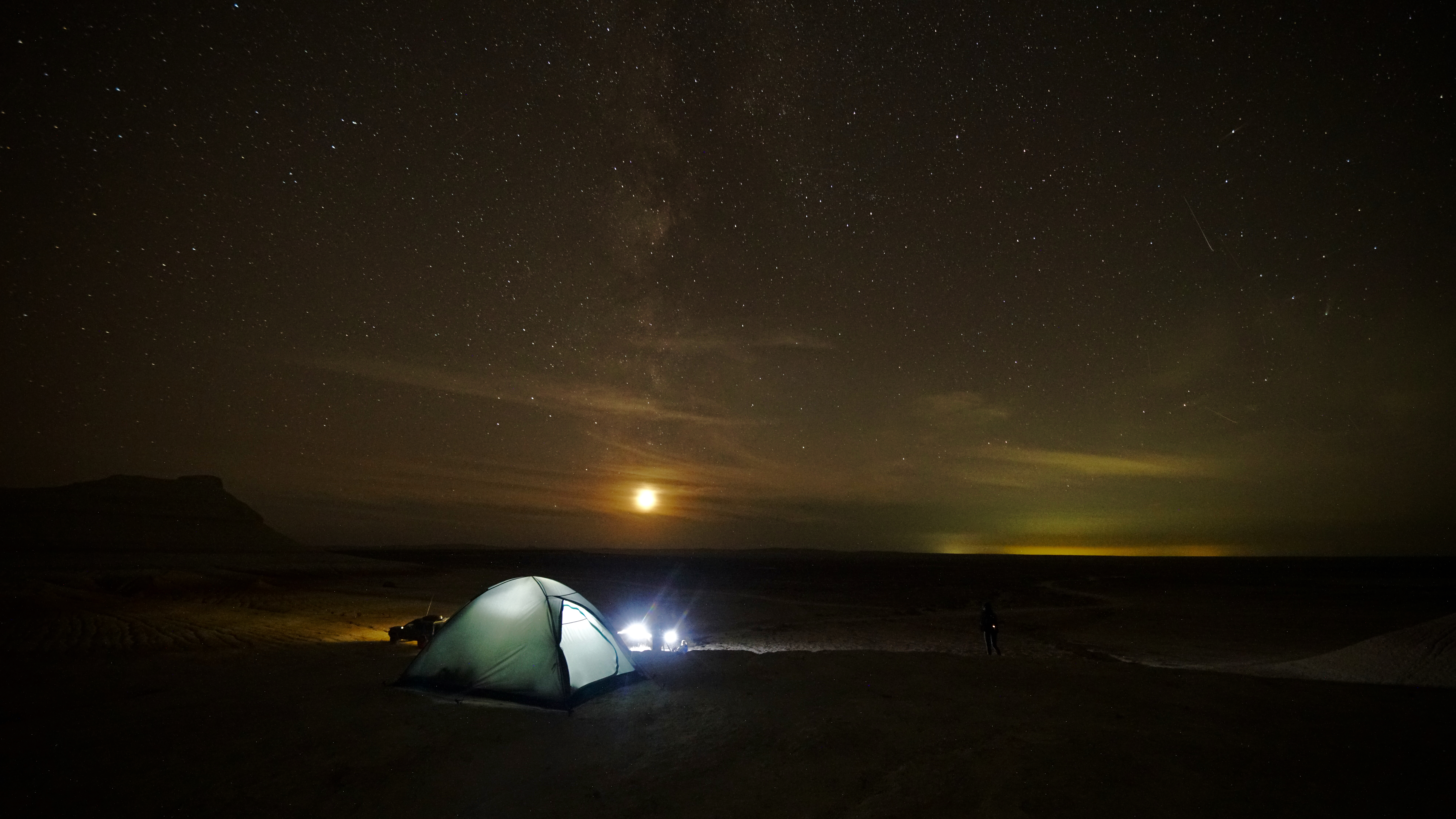
We rush through moments as if racing against something that doesn’t even exist. Yet here, in a land that has not moved for millions of years, time felt generous. The rocks didn’t hurry to erode, the wind didn’t rush to change them. Everything unfolded at its own pace. And maybe that’s the secret—to step aside once in a while, to let time breathe around you instead of trying to chase it. I stopped near a dry riverbed, the kind that once carried the weight of an ocean. The surrounding cliffs were filled with remnants of that forgotten sea—shells, bones, and the sharp triangular teeth of Otodus, the ancient shark that once ruled these waters. I knelt in the dust and brushed sand from a fragment of fossilized coral, its pattern still perfect after epochs. It was humbling to hold time in my hand—to know this desert was once alive with waves and current, long before there were names for any of it. As dusk fell, I made camp one last time. No tent, no roof—just a sleeping bag laid on warm sand. The fire burned low, and the first stars appeared like pinpricks through a curtain. Then the Milky Way unfurled above me—a river of light stretching from horizon to horizon.
Gratitude washed through me—not the loud kind, but a quiet certainty that being alive, here, now, is enough. I thought of the days behind me, the valleys and salt plains, the endless wind that had carved them and carried me. And just before sleep claimed me, I noticed something else: the Milky Way wasn’t just beautiful—it was ancient company. At every point of light, a sun, much older than human memory, orbited by worlds we will never see. The band above me held more than 100 billion stars, drifting through space in a slow spiral dance. I remembered that our solar system circles the galaxy once every 230 million years—a single cosmic heartbeat. Lying there, wrapped in darkness and starlight, I felt suspended between epochs. The sky was not a view; it was a reminder: we are brief visitors on a timeline written in light. The Milky Way is so vast that even if you could travel at the speed of light, it would still take you about 100,000 years to cross it from one side to the other.
“Beneath the Milky Way, I felt it clearly — the universe doesn’t measure us, it meets us.” – R.H.
Return to the Edge of Time – I woke before dawn, long before the sun touched the cliffs. The stars were still visible, fading slowly as breath. My sleeping bag was covered in fine dust, a souvenir of the wind. For a while, I didn’t move. The world was suspended between night and day, silence and awakening. It was the kind of silence that listens back. By the time the first light reached the horizon, I had packed the last of my gear. The 4×4 waited—dust-caked, loyal, a companion more than a machine. I turned the key, and the engine’s growl felt almost intrusive against the quiet. Ahead lay the long drive back to Aktau—the return to roads, to clocks, to people. Yet something inside me resisted the idea of going back. I have been living at the scale of mountains and millennia. Civilization felt like a smaller place. The closer I came to the city, the louder the world became. The first asphalt under my tires sounded unnatural, like stepping onto a stage after weeks of solitude. Traffic lights blinked. Billboards shouted in color.
People hurried across intersections, their faces lit by screens, their pace dictated by deadlines and invisible obligations. The contrast was staggering. Out in Mangystau, I had fought wind, dust, and thirst. Here, people fought time—and mostly lost. I parked near the shoreline, where the Caspian stretched gray and vast. Ships moved on the horizon, silent giants bound by human schedules. For the first time, I understood that most of us live in a constant forward lean—rushing toward what’s next, rarely looking down at the ground that holds us, or up at the stars that still shine with ancient patience. Mangystau had stripped me of urgency. I thought about the fossils, the salt, the wind, the sheer age of everything I had touched. Beneath my boots, this land still carries the memory of the Tethys Ocean, the ancient sea that once covered Western Kazakhstan. In Torysh, spherical concretions lie scattered like forgotten messages—formed when minerals crystallized around a single shell, tooth, or fragment of life more than 40 million years ago. In the cliffs near Boszhira, shark teeth from Otodus obliquus still gleam in the dust, remnants of predators that hunted these waters long before deserts replaced waves. Even the salt domes that rise like frozen storms are older than human imagination—slow, patient upheavals shaped over geological ages. Mangystau is a museum without walls, where every stone is a page in the planet’s autobiography. The rocks never hurry, and yet they change. The sky never shouts, and yet it holds everything. Maybe that’s the lesson—stillness isn’t the absence of movement; it’s understanding the pace of what truly matters. As the sun climbed, I felt gratitude rise with it. For the dust still clinging to my boots, for the silence that had followed me back, and for the knowledge that time—real time—isn’t something we can own. It’s something we pass through, like wind across a dune. The city stirred behind me. The desert breathed somewhere beyond the horizon. And I knew I would return—not to escape the world, but to remember it.
“At the edge of time, you remember: nothing lasts, yet everything remains. The Earth turns its ancient pages, and for an instant, you are allowed to read one.” – R.H.

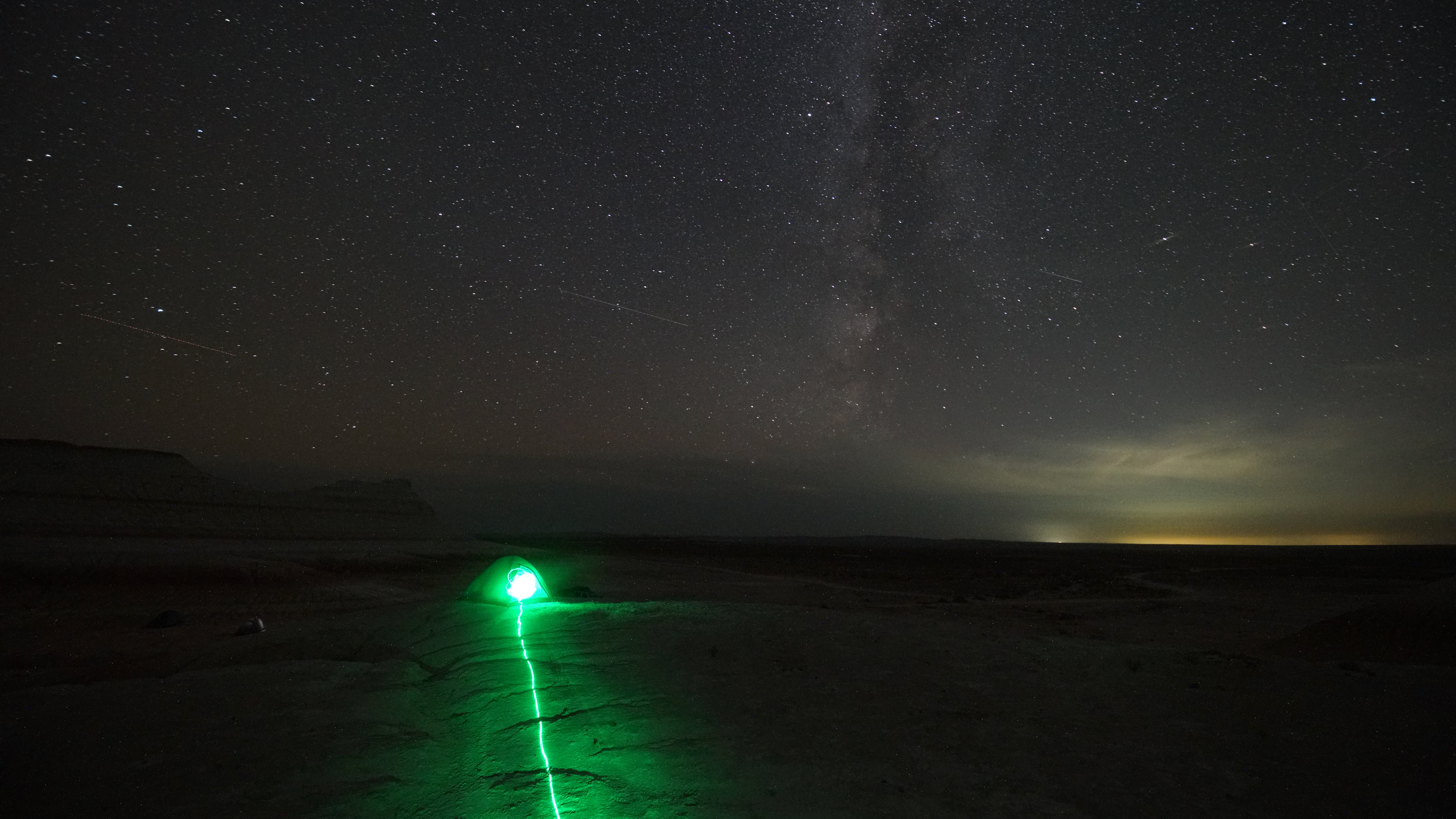
Traces of Light – Back in the city, I caught my reflection in a window—sunburned skin, cracked lips, a faint line of dust still clinging to my collar. For a second, I didn’t recognize the person staring back. The desert leaves its mark not in scars, but in silence. It follows you, lingers in the rhythm of your breathing, in the way you now pause before answering a question, as if still listening for the wind. Days passed in a blur of movement—running water, voices, screens, clocks. Everything worked, everything connected, and yet it all felt strangely distant, like watching life through a pane of glass. I had carried Mangystau home with me, tucked between the pages of my notebook and the memory cards from my camera. But even the best photographs failed to capture what it felt like to stand beneath those white cliffs or sleep under the Milky Way. The images were beautiful, yes—but they were quiet, incomplete, mere reflections of something that had no words.
I began to understand that the camera isn’t a device for keeping time—it’s a way of translating it. Every frame holds more than light; it holds a choice, a moment of stillness within the flow. The lens becomes a reminder that nothing we see is ever permanent. We take pictures not to freeze life, but to remember that it moves. One morning, I looked at my photographs. Boszhira’s ghost towers. Tuzbair’s mirrored salt flats. The delicate stripes of Tiramisu Gorge. Each image glowed softly in the dawn light, and for the first time, I didn’t see landscapes—I saw traces of myself woven through them, not as a subject, but as a witness. The desert had recorded me as much as I had recorded it. I thought of the fossils I’d collected—the fragment of coral, the small tooth of Otodus, sharp and perfect even after millions of years. Those relics, like my photographs, were reminders that time doesn’t erase everything. It reshapes it. It carries memory forward in unexpected forms.
We live our lives believing that we move through the world, but sometimes the world moves through us. Mangystau had done that—it carved small canyons inside me, places of stillness and clarity that no city noise could fill. That night, I walked down to the water’s edge. The Caspian was calm, mirroring the stars above. I lay on the sand and watched the sky the way I had in the desert—waiting for the faint spill of the Milky Way, for the hum of silence that feels almost like understanding. Journeys end, but their echoes don’t. They follow quietly, reshaping how you see, how you listen, how you live. And when I closed my eyes, I realized that every photograph, every fossil, every grain of sand in my pocket was saying the same thing: You were here. You saw. You listened. And for now, that was enough. The Pulse of Time — Time drifts like a quiet river, soft as breath, slow as dawn. We chase it, yet it slips through us— a whisper, a pulse, a single spark in the dark. In stillness, we learn: time is not passing. It is unfolding, and we are unfolding with it.
“Light doesn’t just reveal a moment — it reveals the part of us that was changed by witnessing it.” – R.H.
The Gate to Ustyurt – Adventure, I’ve learned, doesn’t always begin on the open road. Sometimes it begins in an office that smells of paper, ink, and impatience. Getting a permit for Ustyurt National Reserve was less about geography and more about endurance. Forms stacked like small mountains. Stamps, signatures, delays. Each counter led to another corridor, another official who wanted to know why anyone would want to go there. Most people never do. The Ustyurt Plateau is remote even by Mangystau standards — a high, wind-scoured expanse of limestone and solitude stretching toward the Uzbek border. Once part of the ancient Tethys Ocean, it rises like a pale, eroded fortress between deserts, its cliffs dropping sharply into former seabeds and salt depressions. Temperatures swing wildly here, from blistering heat in summer to icy winds in winter. Wildlife survives only by mastery of silence: saiga antelope, steppe fox, golden eagles circling the thermals above chalk canyons. It is a place where emptiness has texture, and distance has shape.
I sat in government buildings under flickering lights, explaining my route, my equipment, my purpose. The clerks listened politely, their eyes tired from routine. When I mentioned the Three Brothers, a faint smile crossed one man’s face — not amusement, but recognition. “You know,” he said quietly, “most people only see them in pictures.” Then he stamped the final page. The sound echoed like a gate unlocking. The process had taken days. By the time I stepped outside, dusk had fallen over Aktau. The wind off the Caspian carried the smell of salt and fuel, and for the first time in a while, I felt the pulse of anticipation again. Bureaucracy, I realized, is its own kind of desert — endless, monotonous, testing your patience instead of your endurance. But the reward, like all deserts, waits for those who keep moving.
That night, I spread my maps across the table in my comfortable tent. The Ustyurt Plateau lay to the northeast, its edges drawn like scars. The “Three Brothers” stood deep inside the reserve — three monumental rock pillars rising from the plain, aligned like sentinels guarding the border between earth and time. I traced the route with my finger: long tracks of nothingness, salt pans, dry basins, and the faint contour lines that marked ancient seabeds. Outside, the wind picked up, rattling the shutters. I packed slowly — extra water, spare fuel, drone batteries, a new air filter for the 4×4. The land ahead was not forgiving. But that was exactly why I needed to go. When I finally turned off the light, I stood by the window for a moment, looking toward the dark horizon. Somewhere beyond it lay Ustyurt — silent, immense, and waiting. The desert doesn’t care who enters it. It doesn’t welcome or warn. It simply is. But for those who listen, it reveals things that maps and coordinates never can. Tomorrow, I will cross the line from known to unknown again — from the documented to the felt. The permit was more than permission; it was an invitation. The next chapter of the land was waiting to be read.
“Maturity is not what time adds to you, but what stillness reveals when everything else falls quiet.” – R.H.
At the Frontier of Memory – The morning’s light was thin when I hit the road, leaving Mangystau’s familiar ridges behind. My permit clutched in hand, I navigated the long dirt track to the Ustyurt Nature Reserve — a place that, existing only on paper, conveys little of its remoteness. Established in 1984, the reserve spans roughly 223,000 hectares and lies on the western cliff-edge of the Ustyurt Plateau, in southwest Kazakhstan. What made the permit so hard wasn’t just the paperwork—it was the question behind it: Why go?
I wanted to cross into a land where salt pans replace roads, and where the border with neighboring countries, such as Turkmenistan, lies just beyond chalk cliffs. The bureaucracy stirred a different kind of wilderness; each stamp, each signature, felt like clearing another checkpoint of the soul. When the gates finally opened, I entered a world of silence and scale. The terrain flattened, then folded into pale chalk escarpments, salt flats shimmering like ghosts, and ridges that reminded me the sea had once ruled this land. Water is scarce; rivers don’t run here—only wells and groundwater springs supply the few pockets of life. I drove in low gear through the scored tracks of ancient marine beds. The dust rose behind the 4×4 like a banner marking my passage. My destination: the legendary formation known as the Three Brothers. These three towering pillars stand sentinel atop the plateau, aligned with the horizon as if built by some unseen culture of stone. I approached them from the east, the late afternoon sun turning the pillars to pale rose and ivory. I parked the vehicle in a depression carved by eons of wind and salt, and hiked the last slope on foot.
The ground cracked beneath me; fossilised shells and shark-teeth fragments glinted in the dust. This was a seabed long ago, abandoned, and yet never forgotten. In my hand, I held a small piece of coral—not much larger than a palm—but its surface bore the signature of time. It whispered something simple: you are passing through, the land remains. As the sky deepened into cobalt, the Three Brothers cast long shadows across the plateau. I camped nearby under no trees, no roofs—just the same vast sky the animals here still roam beneath. In the darkness, I launched my drone once more to capture their silhouette against the stars. Standing there, I realised: the hectic rhythms we live through back in towns collapse here. Days are measured in distance, dust, sunrise, silence—not by meetings or screens. Ustyurt taught me that you don’t just travel the land—you travel its memory. And the pillars before me were not monuments to human ambition, but to time itself. I lay back in my sleeping bag, the drone tucked away, and gazed upward. The Milky Way stretched across the sky in a bright band, ancient light crossing the same empty air that had crossed these plateaus for millennia. I felt quietly thankful—for the permit battles, the remote driving, the salt flats, the fossils, the pillars. Because to reach this place is to arrive not just at a destination, but at a new way of seeing it.
“The permit opened the gate, but the land opened something else: the part of me that still knows how to listen.” — R.H.
Firelight and Curiosity – Night had fallen over Ustyurt. The wind had settled, the desert holding its breath between one heartbeat and the next. I sat in my folding chair beside a small fire, the flames whispering against the cold. The enamel coffee pot hissed and sputtered, its lid clinking with every gust. The smell of burnt ground mingled with salt and dust — the perfume of solitude. This was my classroom. In cities, curiosity is consumed by speed. We rush to know, to define, to conclude. Out here, knowledge comes differently — slower, almost shy. You have to earn it by being still long enough for the world to reveal itself. I watched the embers shift from orange to blue, the sparks lifting and vanishing into a sky so immense it defied imagination. Above me, the stars traced the geometry of ancient truths. Below, the earth told its own in layers of stone and salt. Between them sat one small figure in a chair, cup in hand, trying to listen.
Exploration, I’ve come to realize, isn’t about finding what’s new — it’s about seeing what’s eternal and allowing it to change you. Curiosity begins with humility. You look, and the world looks back. You stop naming things, stop comparing them, stop demanding meaning — and suddenly, everything means something. The coffee was strong and gritty, the kind that settles more than it stirs. I poured another cup and leaned back, watching the Milky Way arc across the sky. It wasn’t just beautiful — it was instructive. Every speck of light up there was a lesson in patience. Stars burn for millions of years and never ask to be seen. The universe doesn’t announce itself; it waits for attention. Maybe that’s what curiosity really is — a form of respect. A fox appeared on the ridge, motionless, ears tilted toward the fire. For a long moment, we regarded each other — two wanderers meeting at the edge of understanding. Then it turned and disappeared, leaving only footprints and a trace of awareness that the desert is never truly empty.
I thought of all the explorers before me — some chasing borders, others chasing themselves. My own journey was less about conquest and more about comprehension. I didn’t want to own this land or give it a name. I wanted to know it the way you see a friend: slowly, without agenda, through shared silence. The fire sank lower, collapsing into red coals. I poured the last of the coffee and let the night fold around me. The solitude was not loneliness — it was presence, distilled. Out here, questions don’t need answers; they need space. And in that space — under a sky older than memory, with nothing but flame and dust for company — I found what I hadn’t even known I was seeking: the quiet certainty that learning is not something you collect, but something that collects you. We explore not to conquer distance, but to slow down long enough for the world to speak. Out here, curiosity becomes a form of respect — a willingness to listen without demanding answers. Exploration is simply the moment when we stop trying to name everything and allow ourselves to be changed by what we see.
Between Dawn and Distance – At dawn, the desert was still dreaming. Ashes from last night’s fire glowed faintly in the sand, and the air held that fragile calm that lives between darkness and day. I poured the last of the water into the kettle and waited for it to boil. The flame hissed softly — a single sound in an ocean of silence. When the first light broke over the horizon, the world shifted from slate to gold, and the land came alive again in quiet tones. It was time to go. Packing up camp in the desert is a ritual. Every rope, every cup, every grain of dust carries meaning. Out here, nothing is trivial. The chair folded with a sigh, the tent disappeared into its bag, and the tracks from last night’s footsteps were already being erased by the morning wind. I loaded the 4×4 and took one last slow look around — the vast plateau, the Three Brothers in the distance, their pale faces glowing in the dawn. The drive west began as a conversation resumed after a long pause. The road — if you could call it that — rippled with corrugations that hummed through the steering wheel.
The land stretched endlessly ahead, flat yet full of texture. The tires carved temporary signatures into the dust, erased seconds later by the breeze. Out here, even movement feels impermanent. As the hours passed, I began to sense the sea again before I saw it — a faint shift in the air, a coolness, a taste of salt carried across invisible distance. The desert was giving me back to the world. But I was not the same. Civilization appeared slowly: faint cell signal, tire tracks, a distant road sign half-buried in sand. Soon the horizon darkened — the Caspian Sea, stretching vast and still, like the memory of another silence. I stopped the car at the edge of a cliff and stepped out. The wind smelled of salt and distance. Below, the water moved gently, eternal in its rhythm. I stood there for a long time, listening. To the sea. To the wind. To the quiet that still echoed inside me. I realized that Mangystau hadn’t taught me about adventure or endurance — it had taught me about attention. That true exploration isn’t about discovering places, but about remembering how to see. We spend our lives surrounded by noise — messages, schedules, demands — until we forget the weight of stillness. The desert reminded me that silence isn’t empty; it’s full of answers waiting for those who stop long enough to hear them. As the sun dropped toward the horizon, the light turned to amber, reflecting off the Caspian like molten glass. I sat on the hood of the car, sipping the last of my lukewarm coffee, and smiled. The journey was ending. But its echo — that deep, resonant stillness — would travel with me long after the tracks were gone.
Out here, routines become survival. Before breaking camp, I checked my water supply; water is not a convenience but a calculation; every sip has distance attached to it. The stove, battered from years of travel, burned just long enough to heat the kettle, and then it went back into its case beside the shovel, compressor, and recovery boards — the desert essentials no one talks about in travel magazines. My map, a creased topographic sheet stained with sweat and dust, lay on the dashboard. The GPS could die, batteries freeze, satellites drift — but paper never lies. I marked the route with a pencil, the old-fashioned way, double-checking bearings before rolling out. In a place where the horizon tricks the eyes, and tracks vanish overnight, navigation isn’t a skill. It’s a form of respect.
The Instinct to Move – Why do we travel? Not for comfort. Not for convenience. Certainly not for control. We travel because, somewhere deep in the marrow of our being, movement is memory. Long before we built borders or clocks, we followed rivers, stars, and herds. We were guided not by plans, but by hunger — for food, for knowledge, for understanding. To move was to survive. To explore was to evolve. That instinct never left us. It only changed its landscape. Today, we no longer cross tundras with spears or sail toward uncharted continents, but the same gene that once pushed our ancestors beyond the horizon still hums quietly beneath the noise of daily life. It’s the whisper that says: go. It’s the pulse that wakes us when we feel trapped. To ignore it is to silence something ancient inside ourselves.
I often think of time as a vast ocean — and we are a single wave rising briefly before sinking back. If the Earth’s history were compressed into one calendar year, humans would appear only in the final seconds before midnight on December 31st. Our entire civilization — every city, every empire, every digital trace — fits in the blink of the universe’s eye. The lesson is simple: the value of now is not measured by its length, but by its awareness. We rush, always looking ahead, but evolution didn’t prepare us for constant acceleration. It prepared us to observe. To listen to wind patterns. To read clouds. To sense the subtle shift of seasons and respond. Modern life has replaced observation with information, but not all knowing is understanding. The desert reminded me that awareness is older than thought. Standing alone in Mangystau, between fossils and stars, I realized that travel isn’t escape — it’s return. Each journey draws us closer to our original rhythm, the one our species has always known: curiosity followed by discovery, discovery followed by humility. When we move through new landscapes, we shed what is stale in us. We are forced to see, to feel, to adapt. That is evolution, still at work. So perhaps we don’t travel to find places — we travel to find perspective. To be reminded that the horizon is not a limit, but an invitation. If you’re reading this, you don’t need a desert or a distant border to begin. You need only to step aside from routine, to listen again to the quiet tug of curiosity. The world doesn’t need more movement — it needs more awareness in motion. Because one day, long after our wave has fallen back into the ocean of time, what will remain are the ripples of the choices we made when we were awake. And right now — this brief, bright moment between eternity past and eternity ahead — is the only time we ever truly hold in our hands.
Einstein once wrote that “the distinction between past, present, and future is only a stubbornly persistent illusion.” I used to read that line with admiration; now I read it with recognition. In Mangystau, it was impossible not to feel it. Time didn’t unfold in a straight line — it pooled, spiraled, folded into itself. A fossil at my feet was both millions of years old and strangely present. A shooting star overhead was already gone before its light reached me. And I, standing in that narrow band between stone and sky, felt like a temporary bridge between two infinities. Travel sharpens this awareness, and our lives are brief, our curiosity is vast — and the universe, in all its quiet generosity, keeps answering back.
The Quiet Horizon – The journey ends the way all real journeys do — not with arrival, but with understanding. When I close my eyes, I still see the white cliffs of Boszhira, the salt of Tuzbair, the layered walls of Tiramisu Gorge. They no longer feel like places on a map; they are parts of an interior landscape now — coordinates of awareness. Mangystau taught me that exploration begins when movement stops. The silence out there wasn’t emptiness; it was language — an older, slower grammar spoken in wind and erosion. It said: Everything changes. Nothing hurries. For a species addicted to speed, that’s an uncomfortable truth. Yet in that stillness, I began to feel the rhythm our ancestors once knew — the pulse of existence unmeasured by clocks, unbroken by noise. We are born into a brief spark of time, a single flash between two eternities. The fossils beneath my boots had waited a hundred million years to tell their story; the stars above me had burned for longer still. Against that scale, our worries, our ambitions, even our names dissolve, and what remains is gratitude.
The quiet horizon teaches a different kind of humility — one that doesn’t shrink you, but places you properly inside the vastness. When you understand how small you are, life expands. When you stop trying to fill every silence, you finally hear it singing. I often think that solitude is not the absence of others, but the presence of everything. Sitting alone by a fire in Ustyurt, I felt connected to everything that had ever existed — not through thought, but through stillness. The flame crackled; a fox crossed the ridge; the Milky Way wheeled overhead. In that moment, I was both insignificant and infinite, a brief observer in a timeless conversation between earth and sky. Now, back among people and signals, I try to keep a fragment of that awareness alive. To walk more slowly. To listen longer. To remember that each second is a frontier that will never return. Exploration doesn’t require a desert — only attention. The same curiosity that drives us across continents can lead us inward, into the uncharted territory of our own perception. And if you ever feel that quiet tug — the one that whispers there is more to see, more to understand — follow it. Let it take you to the edges of maps, or simply to the edges of your own habits. That is how every meaningful journey begins. If you want to know where mine has taken me so far, or where I may be heading next, you’ll find the trails, the stories, and the sand still clinging to the words on my travel blog: www.itchy-feet.com
So I write these words as both a record and a reminder: That we are visitors here, gifted with awareness and a fleeting chance to see. That every horizon, near or far, begins within us. And that gratitude — for dust, for wind, for time itself — is the truest form of discovery. When I look back on it all, the journey feels less like something I finished and more like something that finished me. The desert remains unchanged. The horizon waits, patient. And somewhere between them, the quiet continues — in the breath between thoughts, in the pause before words, in the eternal echo of being here, now.
“Every real journey begins in silence — where the world stops shouting, and you finally hear the part of yourself that has waited a hundred million years to speak.” – R.H.
A Place of Transformation – The Breath Between — When the last light fades and the wind quiets, there is a moment when the desert feels suspended — neither day nor night, neither beginning nor end. That is where this story rests now: in the stillness after motion, in the silence after knowing. What remains is not a destination, but an echo — a soft pulse of awareness that continues beyond these pages. Before the next horizon unfolds, take a breath. Listen. The journey has only changed its direction — it now moves inward. Maybe that’s why the desert feels sacred. Not because of what it gives, but because of what it removes — the noise, the clutter, the illusion of control. Out here, beneath a boundless sky, I find not emptiness but presence. Not isolation, but belonging. And then comes night. The sky unfolds like a revelation — a cathedral of stars, untouched by city glow. The Milky Way rises over the chalk cliffs, so bright it casts a faint shadow on the ground. I lie in the sand beside my van, wrapped in quiet, and feel the Earth spin beneath me. Out here, solitude is not loneliness — it is communion. The desert does not ask questions; it is the question. It strips away the unnecessary, leaving only the essence. What breaks here was never true; what endures is what has always been. If this book has found you, it means there is something you are already searching for. For silence, perhaps. For meaning. For a way to breathe in a world that never stops speaking. I did not travel to Mangystau to prove anything. I went because I felt the pull — the same pull that has guided wanderers, scientists, dreamers, and poets since the first footprints appeared on shifting sand. To travel is not to escape; it is to return. Return to curiosity. To attention. To the delicate awareness that existence itself is rare, brief, and astonishing.
The landscapes described in these pages are real, yes — stone, salt, wind — but they are also metaphors for something greater. Every desert begins as an idea: the wish to step away from noise and into depth. Every road, every horizon, becomes a mirror. You don’t go there to find answers. You go there to remember the questions that matter. If I learned anything on this journey, it’s that time is not something we move through — it’s something that moves through us. We are all made of moments, layered like sediment, shaped by patience and weather. The past is beneath us, the future above us, and in between lies this thin, luminous slice called now. That is where life truly happens. That is where awareness lives. So, wherever you are — on a mountain, in a crowded street, or sitting quietly by a window — listen. The horizon isn’t out there. It’s in you. Because exploration isn’t an act of distance. It’s a state of being. And the greatest discovery any of us can make is this: To be fully present in the brief, magnificent moment we are given — and to give it back, through awareness, gratitude, and wonder. The Desert Blueprint:
“The desert teaches what life forgets: when all noise falls away, the truth remains — we are temporary, yet infinite; small, yet aware. And in that awareness lies the only real transformation.” – R.H.